
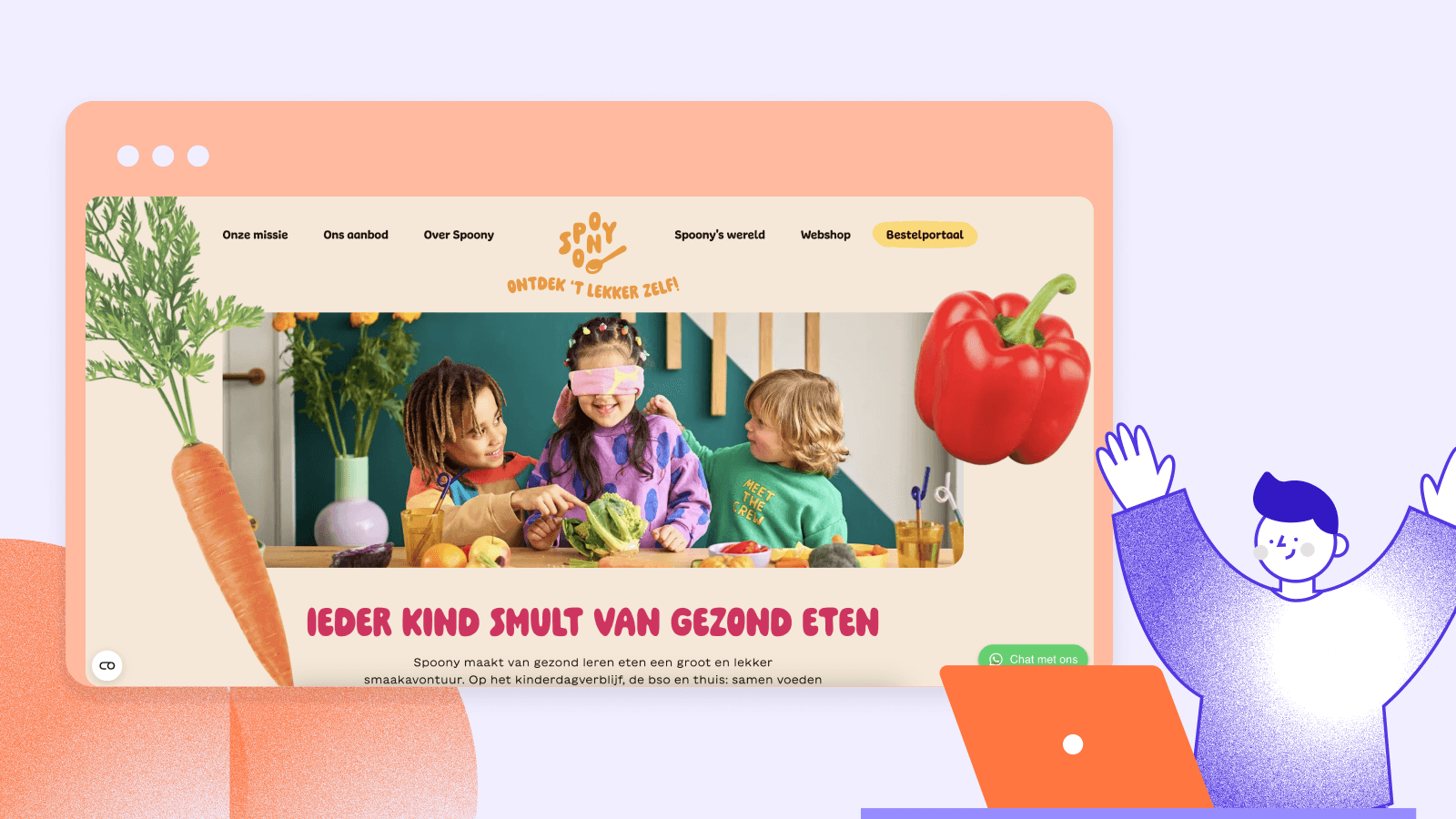
Spoony is a Dutch food startup that helps childcare organizations and parents introduce healthy eating habits to children in a playful way. The company develops meal concepts and educational materials designed to make healthy food accessible and practical in daily routines
When Spoony rebuilt its digital platform last year, the focus was on long-term growth: better segmentation, stronger personalization, and a setup that could scale as the company expanded. Together with digital agency Good News, Spoony implemented a new platform powered by Prepr, enabling content to adapt to different audiences within one structured website.
A few months later, that setup was put into practice during a campaign to promote the Smul & speelpakket. Spoony wanted to reach both childcare organizations and parents. The audience was broad, but the decision-making process was not. Directors, procurement officers, pedagogical professionals and parents all look at the same product from different perspectives.
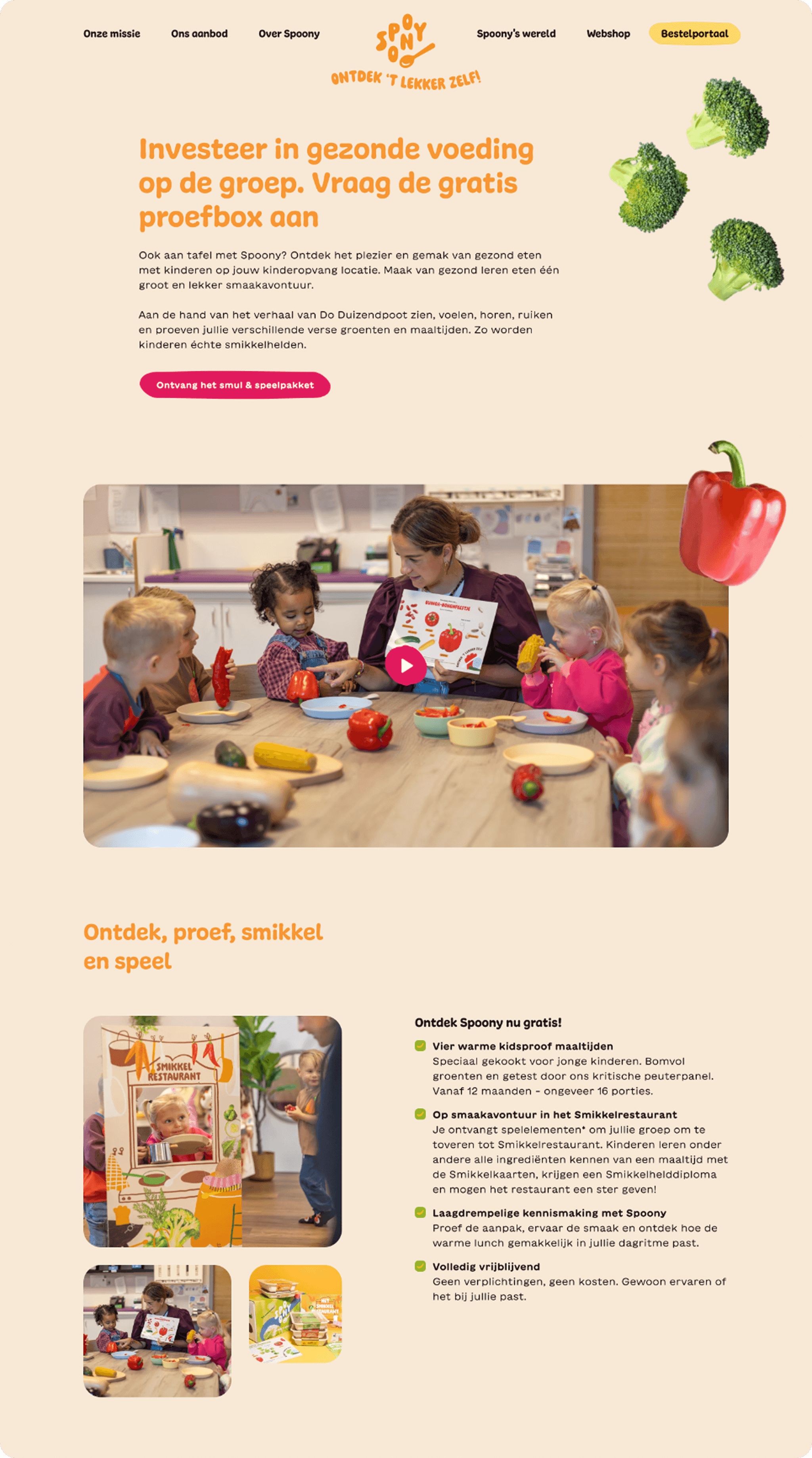
Part of the landing page for the Smul & Speelpakket.
Rather than building separate landing pages for each group, Spoony and Good News used Prepr to create a single campaign page that could adapt its content based on the visitor.
The campaign resulted in 380 new leads for the Smul & speelpakket, concrete package or information requests that could be directly followed up by the Spoony team.
But the real story is how.
Why a single campaign page does not work for multiple decision-makers
Running a campaign for a product like this is not just about generating traffic, it is about guiding different stakeholders through a decision process.
In childcare organizations, decisions are rarely made by one person. Directors weigh budgets and practical implementation, procurement officers look at contracts and logistics, and pedagogical professionals consider how an initiative fits into the daily rhythm of their group. At the same time, parents approach the same product from a different perspective, thinking about its value for their children and whether it aligns with what they want at home.

All of them might land on the same campaign page.
A traditional landing page treats every visitor the same. It presents one story, in one order, with one call-to-action. That approach works when the audience shares the same motivation. In Spoony’s case, it doesn’t.
Information that reassures a director may feel irrelevant to a parent, while a story designed to inspire parents may leave operational questions unanswered for decision-makers within an organization. The challenge, therefore, was not only what to communicate, but how to make sure each visitor found the information that mattered to them.
How the campaign page adapts to each visitor
The idea behind the campaign was straightforward: build one central page, but make it responsive to the visitor.
Using Prepr’s built-in segmentation capabilities, Spoony and Good News set up the campaign so that content can adjust based on where someone comes from and how they behave on the site. Recognition starts at the moment of entry. UTM parameters attached to newsletters and ads indicate whether a visitor is likely to be a pedagogical professional, a director, or a parent. From that first visit, the system places new visitors into the appropriate segment and servess content accordingly.
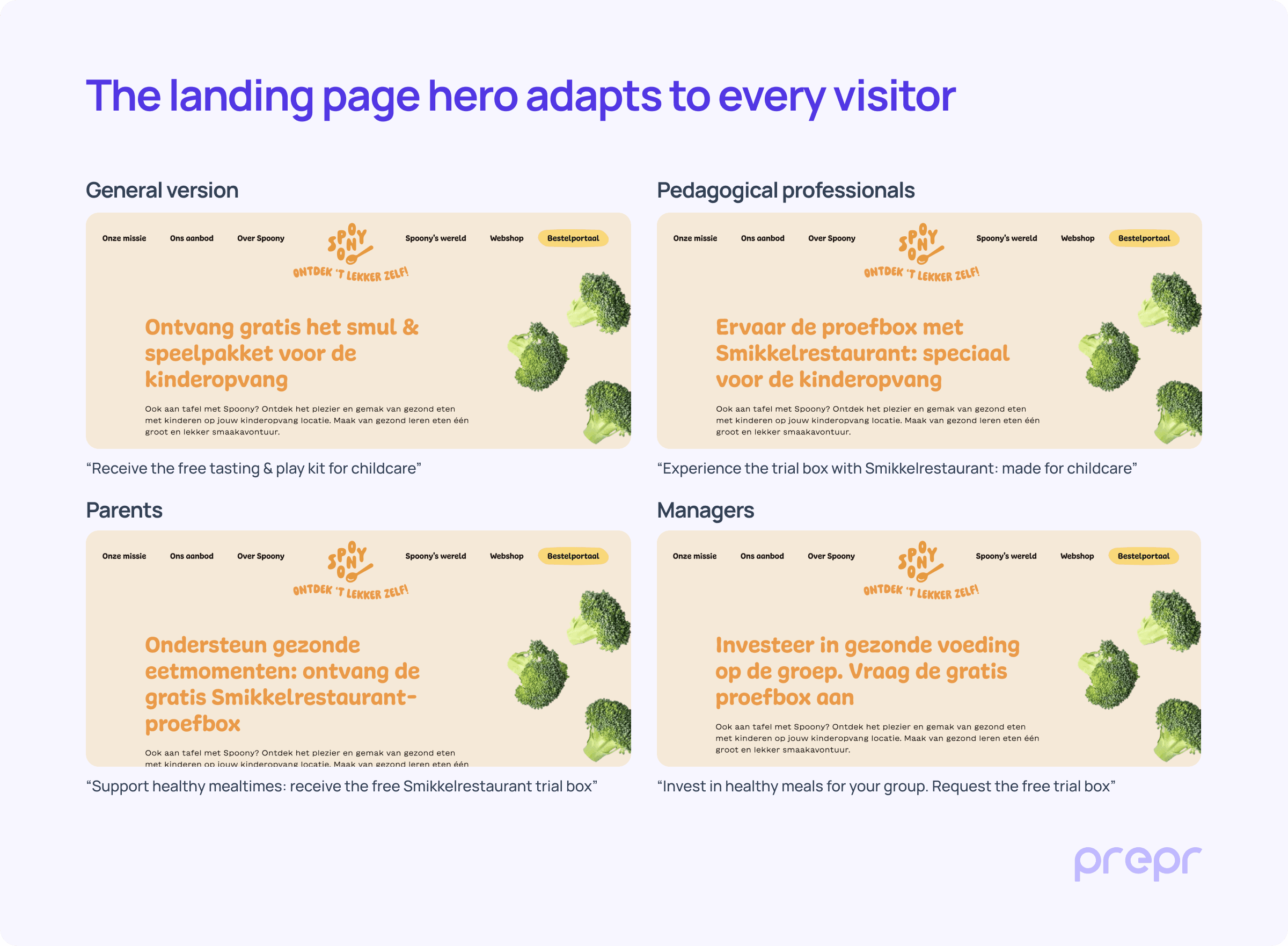
Landing page hero variants for different visitor groups (segments).
The structure of the page remains the same, but specific content blocks change. Headlines, supporting text and calls-to-action are adapted to match the visitor’s likely role and interests.
Parents encounter content focused on the impact of healthy eating and practical ways to introduce the initiative at home or through a parent committee. Pedagogical professionals see information about ordering and how meals can be integrated into the daily routine of a group. Buyers and management are presented with operational details and implementation considerations.
Importantly, the segmentation does not stop at the campaign page. Once a visitor is recognized and placed in a segment, that context can also influence other parts of the website during the same session and even on return visits.
380 new leads: the impact of adaptive content
The campaign generated 380 new leads for the Smul & speelpakket. Compared to previous campaigns, that was a significant increase.
But the number alone does not tell the full story.
What changed was not only the volume of responses but the quality of engagement. Visitors spend more time on the page, move more deliberately through the journey, and reach the call-to-action with clearer intent. Because the content matches their role and likely concerns, fewer questions are left unanswered.
The campaign also provided clearer insight into audience behavior. By segmenting visitors from the start, Spoony can see which groups respond most actively, which messaging resonates and where drop-offs occurr. That information now feeds into future campaigns and ongoing content improvements.
The 380 requests are the visible outcome. The deeper impact is a clearer understanding of how different audiences engage, and how small adjustments in messaging can influence that engagement.
In the final analysis, personalization drives performance
For Spoony, the campaign confirmed that personalization does not have to mean complexity. The page itself remains clear and structured, but certain elements shift depending on who is visiting. Those adjustments are not dramatic, yet they change how different audiences experience the content.
This case illustrates how adaptive content can influence performance when it is applied with intention. When visitors encounter information that reflects their role and their priorities, they move through the page with more confidence and fewer doubts.
That is where the combination of strategy and technology becomes important. The collaboration with Good News, supported by Prepr’s built-in segmentation and personalization capabilities, make it possible to apply audience insight directly within one structured page, without creating separate versions or additional maintenance.
In Spoony’s case, that approach translated into 380 leads from a single campaign and a model that can now be applied to future initiatives.