
Attracting readers is one of the toughest challenges in digital publishing. Every day, hundreds of stories compete for attention, and most are scrolled past in seconds. For local newsrooms, where audiences are smaller and topics are often hyper-focused, that challenge becomes even sharper.
1Almere: A local newsroom with a digital mindset
This is the daily reality for 1Almere, a local news platform covering everything that happens in and around the city of Almere. From politics and education to community events and local stories, the team publishes new articles almost every day. Yet, despite their consistency, editor in chief Vincent Smit started to notice something puzzling: some stories were getting great engagement, while others, equally relevant, were barely being read.
He wanted to understand why. Was it timing? The type of story? Or something as simple as the headline?
Instead of accepting the numbers as they were, Vincent decided to dig deeper. He wanted to uncover what truly makes readers click and how small editorial choices might be shaping the visibility and impact of their work.
The challenge: Which headlines really attract readers?
For digital publishers, capturing attention starts long before a reader clicks. It begins with the headline. That short line of text decides whether a story gets read or ignored.
In most newsrooms, headline writing happens fast. Editors make dozens of quick choices every day, what stories to feature, which images to use, and how to phrase a title that fits the homepage layout. Much of it relies on intuition.
At 1Almere, editors know their audience well. They understand what local topics matter most. Yet, when it comes to understanding why some stories draw strong engagement and others don’t, intuition can only go so far.
Sometimes a factual, straightforward headline will attract many readers. Other times, a softer or more emotional one unexpectedly performs better. There was no clear pattern, making it hard to learn or improve.
So Vincent began to wonder:
- What makes readers stop scrolling and click?
- Are people drawn to emotion or clarity?
- Does starting with context like “City council approves budget” perform differently than starting with emotion, such as “Tough debate over Almere’s new budget”?
Each editor had an opinion. But opinions weren’t enough. Vincent needed proof and a simple way to run a test that could reveal what truly catches the readers’ attention.
The solution: A/B testing headlines with real readers
To move from assumptions to evidence, He decided to test headlines directly with the audience. The goal wasn’t to run a big research project, just to find a practical, repeatable way to understand what readers respond to.
He used A/B testing, a straightforward method that compares two versions of the same element. In this case, the element is the article headline.
Here’s how it works: when an article appears on the homepage, half of the visitors see Version A, and the other half see Version B. Everything else, the image, text, and layout, stays identical. By tracking how many people click each version, the team can see which wording performs better.
Below is one of the early test examples:
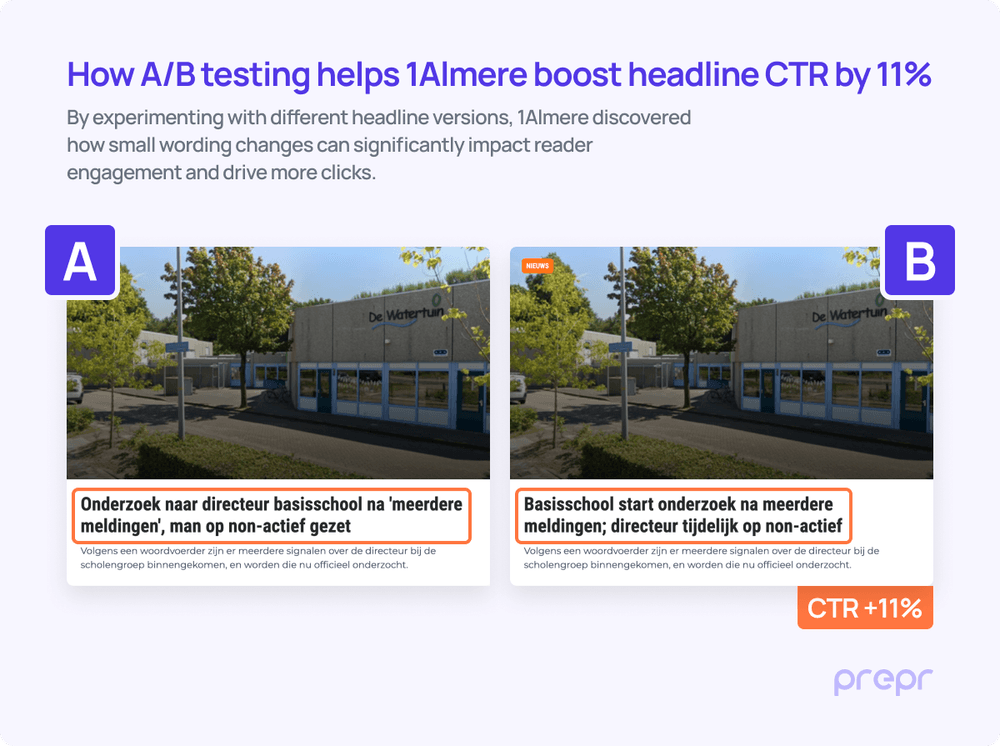
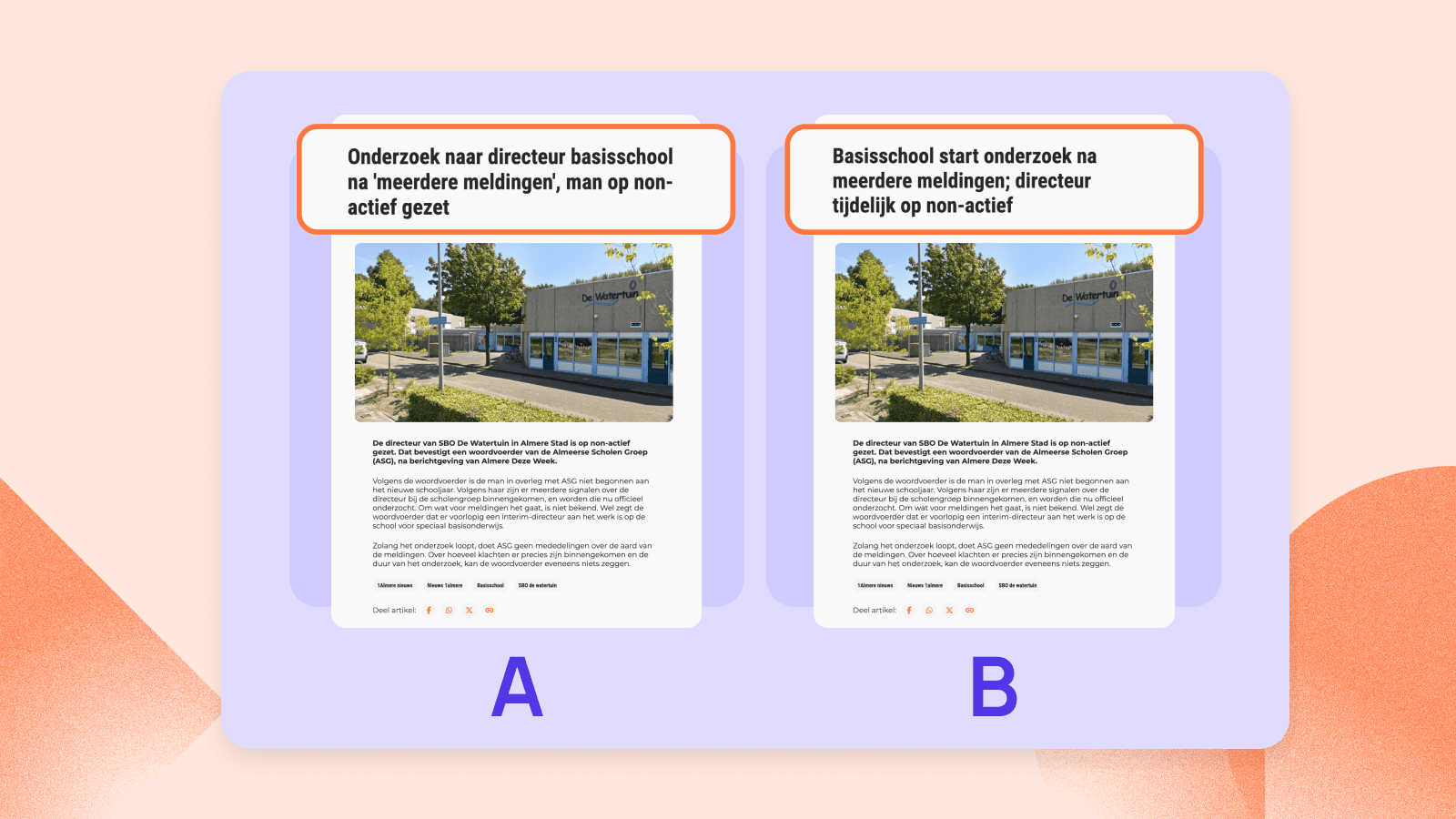
- Version A: “Onderzoek naar directeur basisschool na ‘meerdere meldingen’, man op non-actief gezet.”(“Investigation into primary school director after multiple reports, man suspended.”)
- Version B: “Basisschool start onderzoek na meerdere meldingen; directeur tijdelijk op non-actief.”(“Primary school starts investigation after multiple reports; director temporarily suspended.”)
The difference looks small, but it changes the focus. Version A leads with the subject (“director”), while Version B leads with the action (“primary school starts investigation”). That subtle shift made the headline feel more active and immediate, something readers respond to instinctively.
Each test ran for a few days, focusing on one element at a time. The main metric was simple: the click-through rate (CTR) from the homepage.
This approach fits naturally into the newsroom’s daily routine. Editors can set up a test quickly, monitor the results, and apply the insights immediately to new stories.
What surprised Vincent most was how small changes can make a visible difference. Over time, testing becomes not just a one-time experiment but part of how 1Almere learns about its audience in real time.
The results: +11% more clicks from a single headline change
When the test finished, the data told a clear story.
The second headline, the one leading with the action instead of the person, drew 11% more clicks from homepage readers.
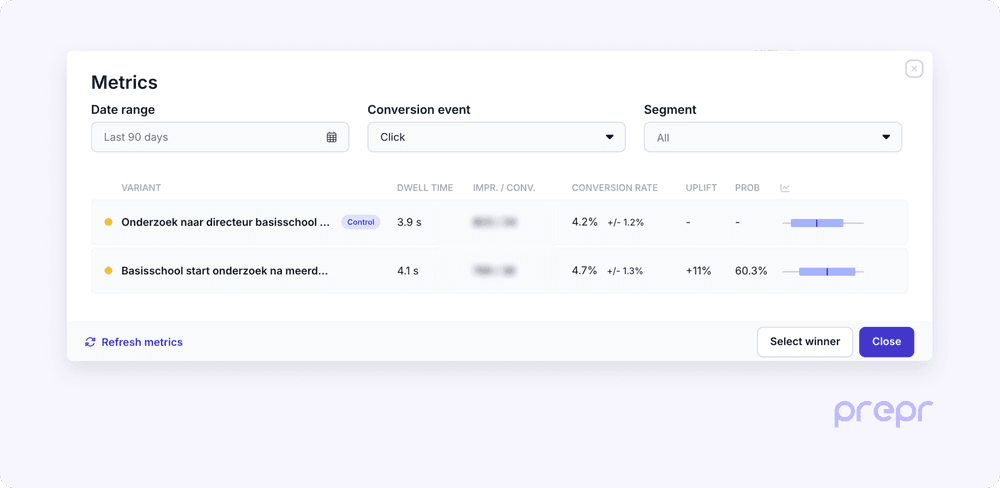
For a local publisher like 1Almere, that improvement was significant. Each percentage point meant more residents engaging with local stories, discovering new topics, and spending longer on the site. It also proved that even small editorial tweaks can have a measurable impact.
But the biggest result isn’t just higher engagement, but it is a mindset shift. Editors begin to see testing as part of storytelling itself. Each experiment becomes a way to learn more about their audience and refine how they communicate.
Over time, this approach encourages more experimentation. The newsroom started exploring variations in tone, sentence length, and framing, turning testing into a natural part of how they create and improve stories.
Why this matters for you
Every newsroom, marketing team, or content creator faces the same challenge: understanding what makes people click, read, and stay. The difference lies in how you approach it.
Vincent’s experiment shows that progress doesn’t always require new tools or major redesigns. Sometimes it starts with curiosity, asking simple questions and being willing to test the answers.
If you manage content, think of testing as a way to listen to your audience in real time. Start small: test one element, compare the results, and keep what works.
In the end, 1Almere didn’t just get more clicks. They built a habit of learning from their readers, one headline at a time.