Steve Jobs once said, “Creativity is just connecting things.”
That line has always resonated with me, because it captures a simple truth: when we connect the right pieces, something greater emerges. We see it in art, in science, in technology and in the way we live our daily lives.
We live in a world that is more connected than ever. Our homes, our cars, our workplaces, even our watches, are constantly exchanging information, learning, and adapting. When everything works together, life feels seamless. When it doesn’t, the gaps are painfully obvious.
Marketing technology is no different.
Over the years, I’ve watched martech stacks grow more powerful and more complex. According to ChiefMartec, the average enterprise now uses around 120 different martech tools, and teams are still adding an average of 6.2 new SaaS apps every 30 days.
But when you step into the shoes of the customer, the story feels very different. An email promises one message, but the landing page starts the conversation all over again. A website greets a first-time visitor and a long-time lead in exactly the same way. A sales call references none of the research the buyer did last week.
We’ve invested heavily in tools, but we haven’t solved the real problem: connection.
Customers don’t care how many platforms we run. They care whether their journey feels seamless across every touchpoint and personalized at every step.
That’s the promise of a truly connected martech platform: not just a collection of tools, but a system that works as one, empowering teams to deliver consistent, personalized experiences everywhere a customer shows up.
Still, most personalization still happens in silos, inside the CRM, inside the email platform, inside the ad platform. Meanwhile, the website, the front door for nearly every journey, remains mostly static.
That’s why so many teams feel the same frustration: we’re working harder, but the customer experience still feels fragmented.
From tool-centric to system-wide personalization
In my conversations with marketing leaders, one theme comes up again and again: they have the right tools, but they don’t add up to the right experience.
That’s because most teams are still treating personalization as a feature that lives inside individual tools. The ad platform reaches out. The CRM remembers. The email platform engages. Each does its part, but none of them work together as a system.
That’s the gap.
Recently, I wrote an article about the Relationship Loop (Listen, Remember, Think, Respond). It’s a simple framework that mirrors how real relationships work: every signal we capture enriches our understanding, every insight helps us adapt, and every response builds trust. When you apply it in your marketing, personalization stops being about clever tactics in isolated channels and starts becoming a continuous, adaptive process across every interaction.
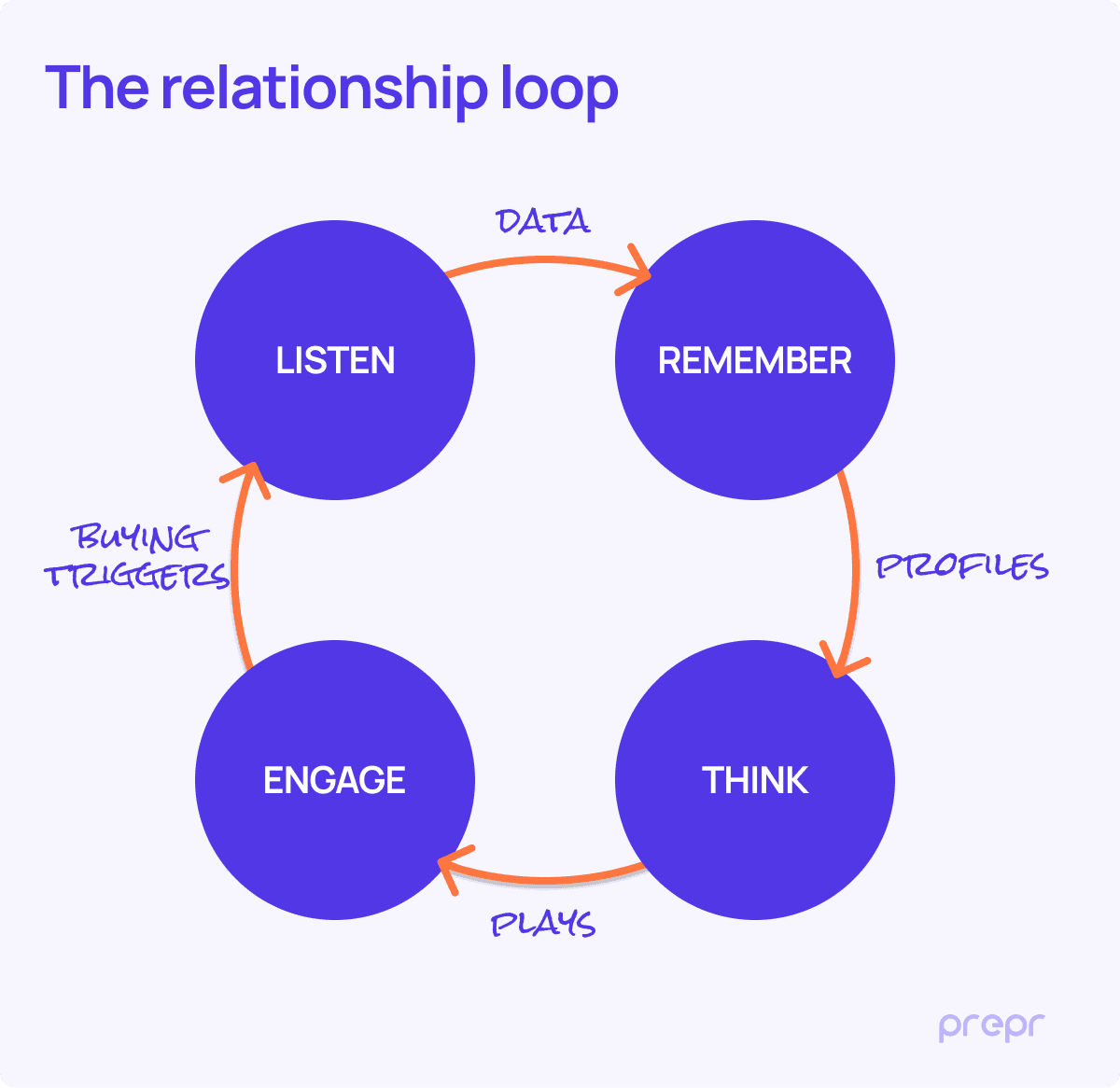
The Relationship Loop connects every interaction, listen, remember, think, and engage, creating one continuous, personalized journey.
The website plays a central role in this shift. It’s the one place where signals from campaigns, emails, and CRMs naturally converge. It’s also the one touchpoint every buyer interacts with, often multiple times before making a decision. And most importantly, it’s where the loop comes alive.
All the listening, remembering, and thinking that happens across your stack only creates value if you can respond in real time. If the website stays static, the loop breaks. But when the website becomes adaptive, it stops being a digital brochure and becomes the execution layer of system-wide personalization.
Unlike a traditional website that shows the same message to everyone, an adaptive website changes with each visitor. It pays attention to what people do, remembers their history, understands the context, and responds in the moment. The result is a journey that feels relevant, personal, and continuous.
I’ve gone deeper into this idea in Websites that work for every visitor: discover adaptive websites. For now, think of the adaptive website as the stage where all the signals from your stack turn into actual experiences.
Why this matters now: 73% of customers expect you to know them, do you?
The urgency behind this shift isn’t just about technology. It’s about people.
Buyers today expect companies to know them and adapt to them. According to Salesforce’s State of the Connected Customer report, 73% of customers expect businesses to understand their unique needs and expectations. At the same time, journeys have become increasingly fragmented.
McKinsey research shows that B2B buyers now use more than ten different channels before making a purchase decision. And those journeys are anything but linear. Buyers loop back, revisit, and jump between digital and human interactions in ways that no funnel diagram can neatly capture.
Speaking of which, I recently explored this in a piece about why the B2B marketing funnel doesn’t work anymore. The funnel suggests a straight line from awareness to purchase, but reality looks more like a radar, signals moving in every direction, overlapping and repeating. This non-linear behavior makes consistency and connection across the stack even more critical.
And while the pressure to deliver relevance across all of those touchpoints is rising, budgets are not. Gartner’s 2023 CMO Spend Survey revealed that marketing budgets have dropped to just 9.1% of company revenue, down from 11% the year before.
What does all of this mean?
Customers expect more, they interact across more places, and marketing leaders are being asked to achieve this with fewer resources. This is why connection matters so much right now. Not because we need more tools or more data, but because we need to make what we already have work as one system. Without that, even the most advanced martech stack will fail to deliver the experience customers expect.
Extending the adaptive website vision across the stack
Making a website adaptive is the first step, but it’s not the whole story.
A website that adjusts to visitors in real time creates enormous value on its own, yet the real potential comes when that adaptiveness extends across the entire marketing stack. That’s when every signal, from every channel, contributes to one continuous experience.
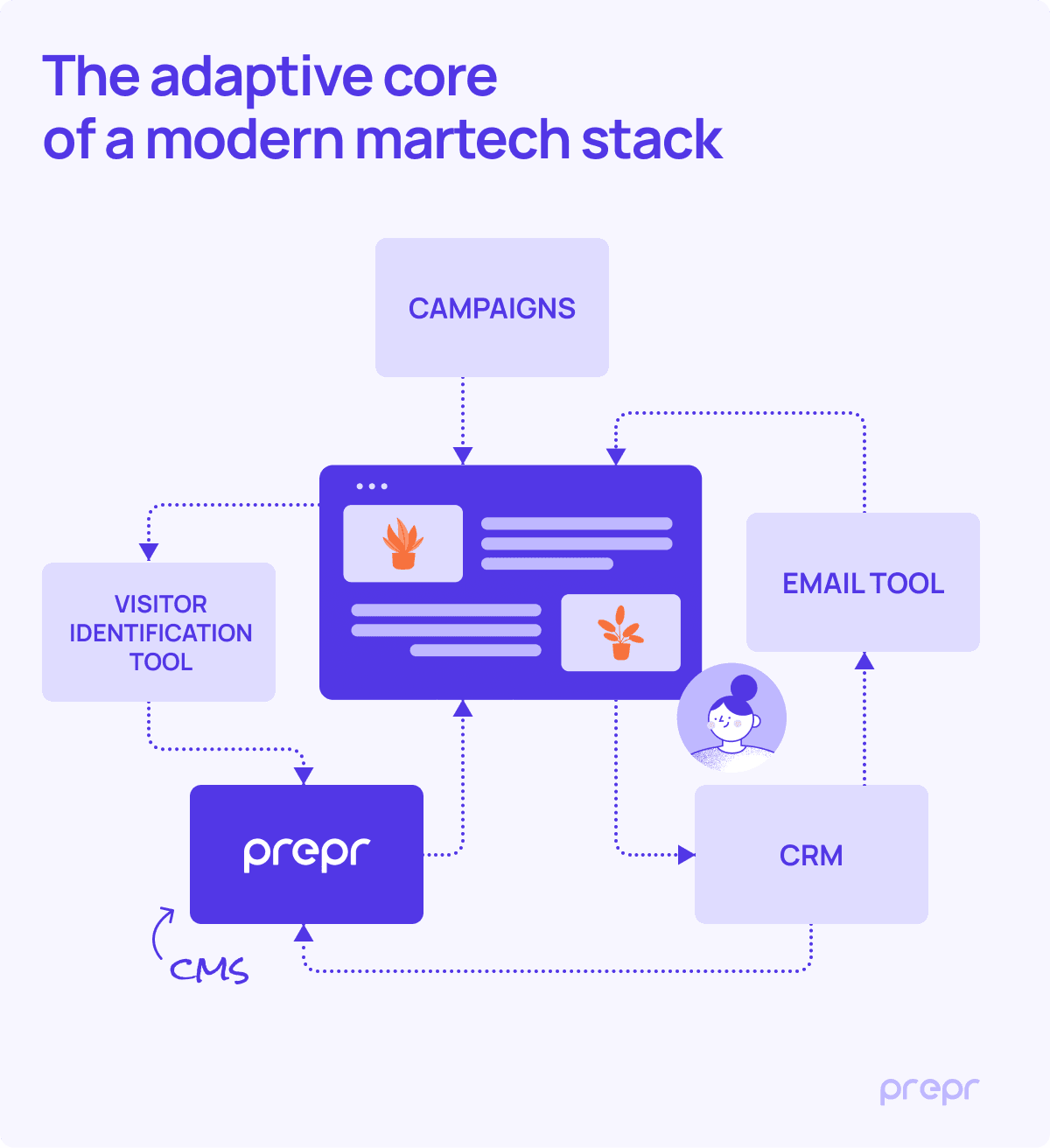
When your CMS, CRM, campaigns, and email tools work as one, every signal adds context. Prepr CMS connects them all, turning your website into the place where data becomes experience.
This matters because most martech tools were designed to operate in isolation. Paid campaigns optimize for clicks. Visitor identification tools surface firmographic insights. CRMs capture and organize customer data. Email platforms deliver messages and track engagement. Each is powerful in its own right, but without connection, they add up to a fragmented experience.
When these tools work together, however, they form a loop.
- Campaigns bring people in.
- Identification tools add context
- The CRM remembers history.
- Email carries the conversation forward.
And the website becomes the execution layer where all of that intelligence turns into a real experience.
A connected business journey: how Acme Bank personalizes every step
To see how it works in practice, let’s look at Acme Bank, a company that helps growing businesses secure financing.
In this example, we’ll follow David, the founder of a mid-sized SaaS company looking for a 400k business loan to expand operations. His journey shows what happens when the full marketing stack, from visitor identification to CRM and email, connects through a headless CMS to deliver one seamless, adaptive journey.
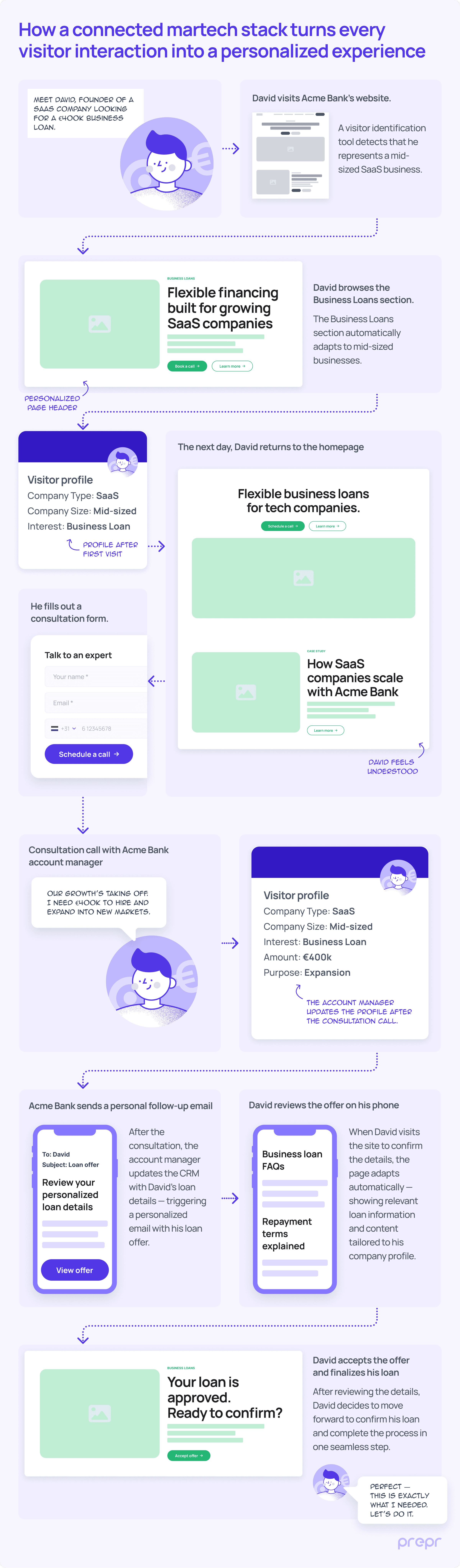
David’s journey with Acme Bank shows how every step stays connected, from first visit to approved loan, through a martech stack that listens, remembers, and responds in real time.
1. Visitor identification: Personalization from the first click
David visits Acme Bank’s website for the first time.
A visitor identification tool instantly detects that he represents a mid-sized SaaS company, not a consumer or a large enterprise. The website adapts automatically. Instead of generic business content, the homepage highlights “Flexible financing built for growing SaaS companies.”
The business loans section updates too, featuring relevant case studies, tailored loan examples, and calls to action that speak directly to SaaS founders.
After that first visit, a visitor profile is created and stored in the system, capturing key details like company type, size, and interest in business loans. The next day, David returns to the homepage.
This time, the experience feels even more relevant.
The header now says “Flexible business loans for tech companies”, and the recommended articles reflect his previous browsing. For David, it feels like continuity. For Acme Bank, it’s automation at work, the website using saved data to build recognition and trust.
2. CRM: Building memory
Encouraged by what he sees, David fills out a consultation form to talk to an account manager.
During the call, he explains that his company is expanding into new markets and needs around 400k in funding.
The account manager updates this information in the CRM, enriching David’s profile with new details: company type, size, interest, loan amount, and purpose expansion.
This richer profile becomes the foundation for everything that happens next.
3. Email: Extending personalization beyond the site
After the consultation, Acme Bank automatically sends a personalized follow-up email.
The subject line reads: “Review your personalized loan details.” When David opens it on his phone and clicks through, the website already knows who he is.
The page adapts immediately, showing loan details, repayment terms, and FAQs specific to SaaS companies looking to expand. Even though he’s on a new device, the experience feels consistent.
Finally, after reviewing the offer, David accepts the terms.
That’s because the CRM, email platform, and headless CMS are connected, sharing the same profile data and context across every touchpoint.
Every system works together, carrying the conversation forward without any restarts.
The adaptive website: the execution layer
In David’s journey, the adaptive website is where everything comes together. Visitor identification provides instant context from the very first visit. The CRM and email tools build on that context, enriching the profile and keeping the conversation going across time and device.
The website becomes the execution layer, the place where all those signals turn into real, personalized experiences. For David, that meant a financing journey that felt clear, relevant, and consistent from the first click to the final decision.
This is the vision: a marketing stack that doesn’t just collect data in silos, but works as one connected system, with the website as the stage where connection becomes experience.
The three big wins of adaptive systems
When marketing teams extend the adaptive website vision across their stack, the impact goes beyond nicer landing pages or smarter email clicks. The real value lies in three outcomes that matter most to marketing leaders today:
Consistency. Every touchpoint becomes part of a single, connected conversation. Buyers no longer feel like they’re reintroducing themselves at every stage, because signals flow across tools and the website carries the journey forward.
Efficiency. Instead of working harder inside each tool, teams make their existing stack work smarter together. Data silos shrink, duplicated effort decreases, and more of the stack’s actual potential is put to use.
Impact. The payoff is measurable. McKinsey found that companies embracing personalization strategies can drive 10–20% revenue uplift. When every interaction feels timely, relevant, and human, buyers move faster and conversion rates rise.
This is the strategic advantage of adaptive systems. They don’t just personalize campaigns, but they create connected experiences that build trust and momentum across the entire buyer journey.
In marketing, as in life, connection wins
Here’s the hard truth: the future of personalization will not be won by teams who optimize subject lines or retargeting ads. It will be won by organizations that build adaptive systems, systems that listen, remember, think, and respond across every touchpoint.
That’s how you deliver experiences that feel consistent, relevant, and deeply human. And that’s how marketing finally fulfills its promise: not just to generate leads, but to build adaptive, trust-driven relationships at scale.
Because just like in the rest of our lives, when systems are connected, everything works better.