

Most companies have never been asked about the carbon footprint of their stack. They will be.
Every tool subscription, every API call, every redundant data transfer runs on physical servers somewhere, consuming electricity and generating heat.
Digital has always carried the reputation of being clean. No factories, no shipping, no physical waste. But as stacks become more complex, the amount of infrastructure required to keep them running grows with them.
The energy cost of digital infrastructure has become more visible with the rise of AI and the growing discussion around data centre consumption. But the same logic applies to the rest of the software ecosystem as well.
More procurement processes now include ESG (Environmental, Social, and Governance) criteria, and new regulations, including the EU Greenwashing Directive, require companies to support sustainability claims with clear evidence rather than broad statements. This shift is expanding across the EU, and the pace is accelerating.
Why do more tools mean more environmental impact?
Most teams don't typically think about their stack in terms of energy use. They think in terms of capability.
A tool is added to solve a specific problem. Content management sits in one system, personalisation in another, A/B testing in a third. Analytics is handled separately, and a CDP is introduced to connect everything.
According to the analysis of Gartner's 2025 Marketing Technology Survey, the average enterprise marketing organisation now uses 91 distinct tools, up from 78 just a few years ago. Yet only 33% of those tools are fully utilised. Companies are paying for infrastructure that generates emissions and delivers no value.
What rarely gets discussed is the physical reality behind all of it. Every additional tool means additional API calls, and every API call is a server computation happening somewhere in a data centre. Those computations generate heat, and cooling that heat accounts for roughly 40% of a data centre's total electricity consumption.
That complexity shows up in different ways. User data, for example, often gets duplicated across multiple systems. The same profile may exist simultaneously in a CMS, a personalization engine, an analytics platform, and a CDP, creating additional storage, syncing, and processing behind the scenes.
Why companies are starting to look more closely at digital infrastructure
For many companies, sustainability reporting now extends beyond physical operations to digital infrastructure. And their agencies are part of that equation.
Large organisations across the EU are already under pressure to report on emissions across their supply chains. Under the Corporate Sustainability Reporting Directive (CSRD), companies must report on indirect emissions across their entire supply chain, which includes the digital tools and vendors that agencies use on their clients' behalf. Digital infrastructure is increasingly part of that discussion.
At the same time, procurement processes include sustainability and ESG requirements, and companies are facing growing pressure to make sustainability claims specific, measurable, and verifiable.
That changes the nature of conversations between companies and the agencies they work with.
The question is no longer limited to performance, scalability, or delivery timelines. Agencies are also being asked to explain how their technology choices are made, how data is handled, and whether unnecessary complexity exists inside the stack.
Most clients are not expecting agencies to calculate the exact carbon footprint of every API call. But they are starting to look more closely at whether their partners are making considered infrastructure decisions or simply accumulating tools over time.
What a leaner stack means for your footprint
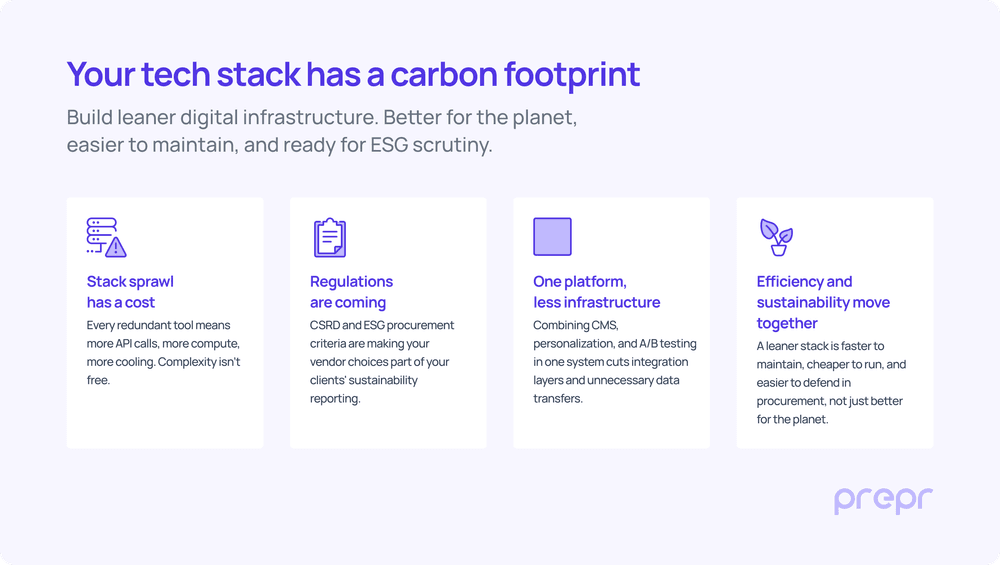
Stack sprawl is not just an operational problem; it also carries an environmental cost. The solution is not about stripping back capability, but about being more intentional with the tools you choose and whether they do more with less.
A single platform that handles content management, personalization, and A/B testing in one place replaces a chain of five tools and the integration layers connecting them. Fewer moving parts means fewer API round-trips, less compute per unit of output, and a simpler architecture that is easier to maintain and hand over to a client.
Performance efficiency and environmental efficiency move together. The same architectural decisions that make a stack faster also make it lighter on infrastructure.
What a leaner stack looks like in practice
At Prepr, we chose early on to keep more of the content workflow inside a single platform rather than spreading it across multiple tools and integrations. Content management, personalization, and A/B testing work together in the same system, which reduces the amount of infrastructure running behind the scenes.
That also changes how data moves. Personalisation also runs on the edge, which reduces unnecessary data transfer between systems and allows content decisions to happen closer to the user.
Our servers run on renewable energy, data is hosted within the EU, and hardware is recycled responsibly at the end of its lifecycle. We're also committed to ongoing measurement and reduction of our operational footprint as we scale.
None of this makes digital infrastructure impact-free. But we believe the industry is moving toward a more considered approach to architecture, where efficiency, maintainability, and sustainability are increasingly connected.
The question most agencies haven't answered yet
Digital infrastructure has always had an energy cost. What is changing is whether that cost is visible, measurable, and defensible to the companies now being asked to report and justify the systems behind their digital operations.
A leaner stack is not just better for the planet. It is faster to maintain, cheaper to run, easier to explain, and better positioned in a procurement context where ESG criteria are becoming standard rather than exceptional.
Companies are increasingly treating digital infrastructure as a technical and strategic question rather than simply a procurement decision. Agencies and vendors that can help reduce unnecessary complexity will be better positioned as those expectations continue to evolve.
We'll be at the MarTech Summit Stockholm on May 26. If you're working through a stack evaluation or want to understand what a leaner content layer looks like in practice, we'd like to compare notes.