


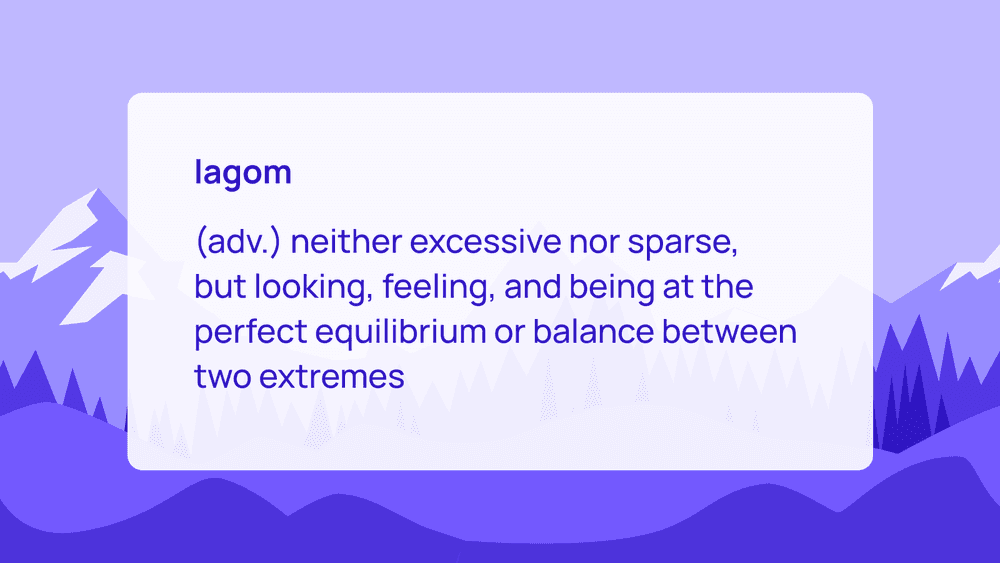
There’s a word you hear often in Sweden: Lagom.
It doesn’t translate neatly. People explain it as “just the right amount,” but that only gets close. It’s less about quantity and more about judgment. Knowing when something is enough.
As part of our expansion into the Nordics, we’ll be in Stockholm soon for the Stockholm Martech Summit. In the weeks leading up to it, we’ve been trying to understand how people work, how teams make decisions, and what they value.
That’s where we came across lagom.
At first, it felt like one of those cultural terms that gets repeated in articles without adding much. But it kept showing up. In conversations about work, in design references, and in how teams organise themselves.
The more we looked at it, the more familiar it started to feel. Not because of culture, but because it reflects how we’ve been thinking about building Prepr.
Lagom is about balance. Doing what’s needed, without adding what isn’t.
You see the same idea reflected in well-designed products. They don’t try to cover every possible use case or overload you with options from the start. Instead, they offer what’s needed, behave in predictable ways, and avoid adding complexity too early.
That balance is difficult to get right, but it’s exactly the line we try to stay close to with Prepr.
A CMS doesn’t need to support every use case
Where lagom becomes practical is in how you define what your product is actually for.
A lot of content platforms expand over time. They try to support more use cases, more industries, more ways of working. This often leads to systems where setting up even simple use cases takes longer than expected.
With Prepr, we made a more deliberate choice early on.
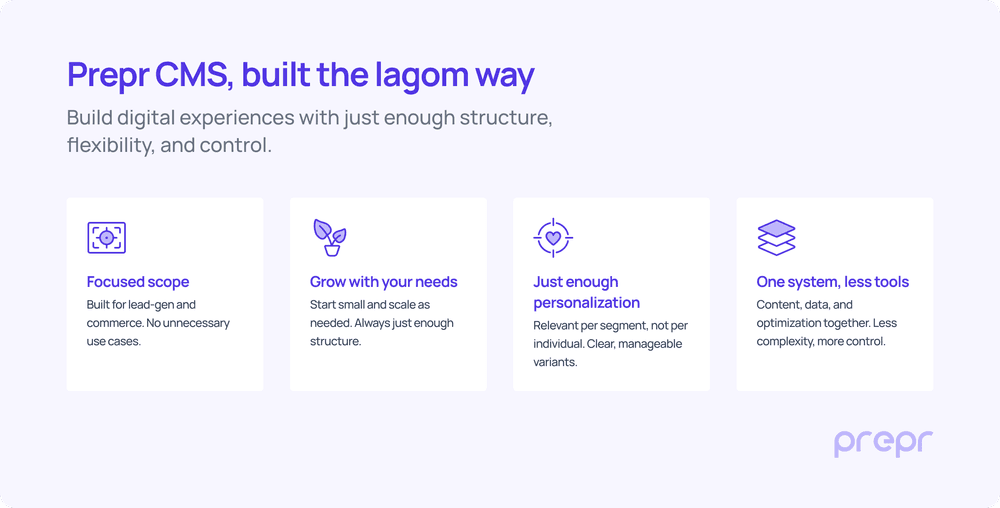
We focus on lead-generation websites and e-commerce. That’s a specific scope, and it’s intentional. Instead of trying to support every possible scenario, we concentrate on the cases where structure, speed, and clarity directly impact conversion and business outcome. That’s where the idea of lagom comes in: doing what’s needed for a clear purpose.
The same thinking applies to pricing.
“Enterprise capabilities without enterprise pricing” is, in many ways, a lagom statement. Most teams need a certain level of functionality, but not the full weight that usually comes with enterprise tools. The goal is to provide what’s required to run serious digital experiences, without forcing teams to pay for features they won’t use.
It’s a more balanced way of building and packaging a product.
A CMS that starts small and grows with your needs
When you open a new CMS, the first experience often sets the tone.
In many cases, that means setting up a structure before you can do anything else. Defining content types, thinking through relationships, deciding how everything should connect. It makes sense in theory, but it also slows things down early on.
With Prepr, we’ve tried to keep that initial step straightforward.
You can start with a basic structure, publish content, and adjust as you go. Pages, reusable content blocks, and references are already part of the system, so you don’t have to design everything from scratch before seeing results. In this case, you have enough structure to get started quickly, without removing the flexibility to adapt later.
That balance also shows up in how different people use the system.
Editors can work with content without needing to think about how everything is structured behind the scenes. Developers get a setup that behaves consistently, so they can focus on building instead of working around the CMS. Marketers can create and adjust pages without having to rethink the entire setup each time.
Each role works with what they need, without being pulled into unnecessary complexity.
Personalization in a CMS is a matter of balance
Personalisation is often treated as something you should push as far as possible.
In some cases, that makes sense. There are products where every interaction benefits from being tailored to the individual. But for many websites, especially in lead generation and e-commerce, that level of complexity isn’t always necessary. It can make content harder to manage and harder to keep consistent.
At the same time, doing no personalisation at all isn’t the answer either. It means showing the same content to everyone, regardless of who they are or what they’re looking for.
With Prepr, the approach is more measured. Personalisation is built into the CMS itself, so it becomes part of how content is created and managed, rather than something added on later.
Instead of trying to personalise every detail, the focus is on making a few clear distinctions. Using segmentation, content is adapted for groups of visitors based on behaviour, context, or source. That already covers most real use cases, without introducing unnecessary complexity.
Rather than showing too many variations or constantly changing messages, the experience stays consistent, with only the parts that matter adjusted. The goal is not to make visitors feel targeted, but to make the content feel relevant.
A/B testing supports that process. It’s used to compare specific changes and understand what works better, not to run endless experiments. In that way, personalisation becomes something you can improve step by step, instead of something that keeps expanding.
In many setups, personalisation, testing, and data are handled across different tools. Bringing them closer together reduces complexity and keeps the system easier to manage.
We’re still learning what “enough” means in practice
We’re still early in our journey in the Nordics, and we’re learning as we go.
What stood out to us is how often the idea of Lagom comes back in practical decisions. In defining scope, in how products are structured, and in how much complexity is actually needed.
It’s a way of thinking that translates well to digital products.
For us, it has meant focusing on a clear use case, making the product usable from the start, and approaching personalisation in a way that stays manageable over time.
Not everything needs to be built in, configured, or optimised from day one. In many cases, knowing what to leave out is what makes a system work.