
Organizations today have more insight into visitor behavior than ever before. They know which campaigns drive traffic, which pages people visit, and where they leave the website. Those insights are widely used to optimize campaigns, content, and conversion paths.
Yet many websites still present every visitor with the same homepage, regardless of why they arrived. Someone looking for information on one topic is often shown the same hero image, featured content, and calls to action as someone with a completely different intent.
At the same time, visitor expectations have changed. People have become accustomed to digital experiences that adapt to their interests, whether on streaming platforms, e-commerce websites, or search engines. While they don't expect every website to know exactly who they are, they do expect to find relevant information quickly.
Most organizations recognize that expectation, but many still see personalization as a complex initiative requiring extensive data, specialized tools, and significant investment. As a result, it is often postponed before the first experiment even begins.
Why so many personalization projects never get started
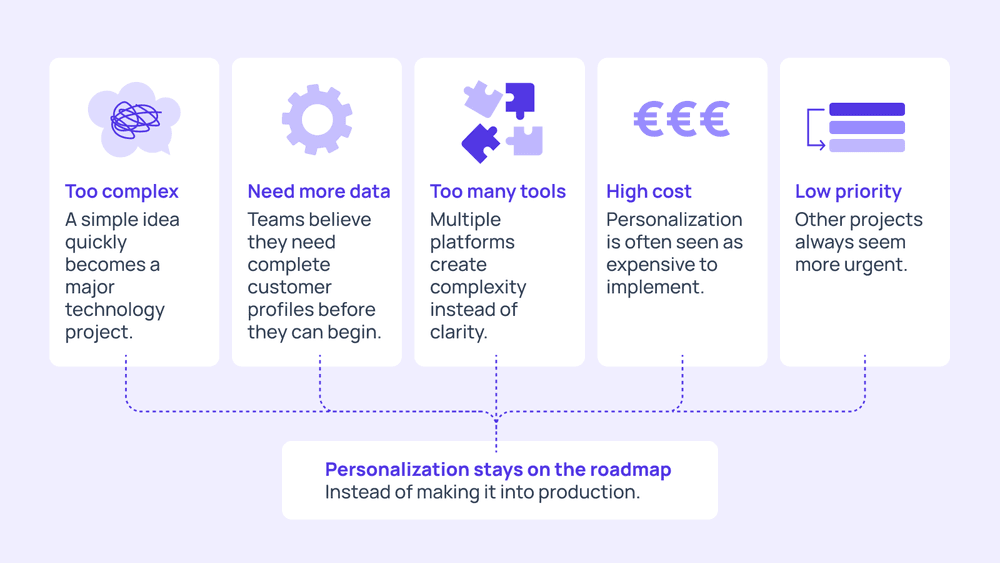
One reason many organizations struggle to move beyond discussion is that personalization is often presented as an all-or-nothing initiative.
The conversation quickly shifts to customer data platforms, recommendation engines, AI models, and dedicated personalization tools. As a result, a relatively simple idea, show visitors content that matches what they came for, quickly becomes a significant technology project.
For some organizations, that level of sophistication makes sense. But it has also created the impression that personalization only becomes possible once the entire technology stack is in place. As a result, many teams postpone it.
What often gets overlooked is that effective personalization does not necessarily require a complete customer profile or a dedicated personalization platform. In many cases, organizations already have enough information to make their websites more relevant.
This is also the approach we take at Prepr: personalization should be part of the content workflow rather than a separate layer of complexity. By connecting content with behavioral data, teams can use existing visitor behavior to start adapting experiences.
A visitor who repeatedly reads articles about a specific topic is providing a signal. Someone exploring a particular product category is providing another. The challenge is often not collecting more data, but finding practical ways to act on that behavior.
That was also DokterOnline's starting point. Rather than collecting more data, the team looked at how existing visitor behavior could be used to make the homepage more relevant.
The power of small adaptations
One of the biggest misconceptions about personalization is that every part of the experience needs to change. In practice, a limited number of adaptations can already make a website feel more relevant.
On a homepage, first impressions are often shaped by just a few elements: the hero image, featured content, and recommended articles or products. Adjusting these elements based on what a visitor has already shown interest in can make the experience more relevant without changing the overall structure of the website.
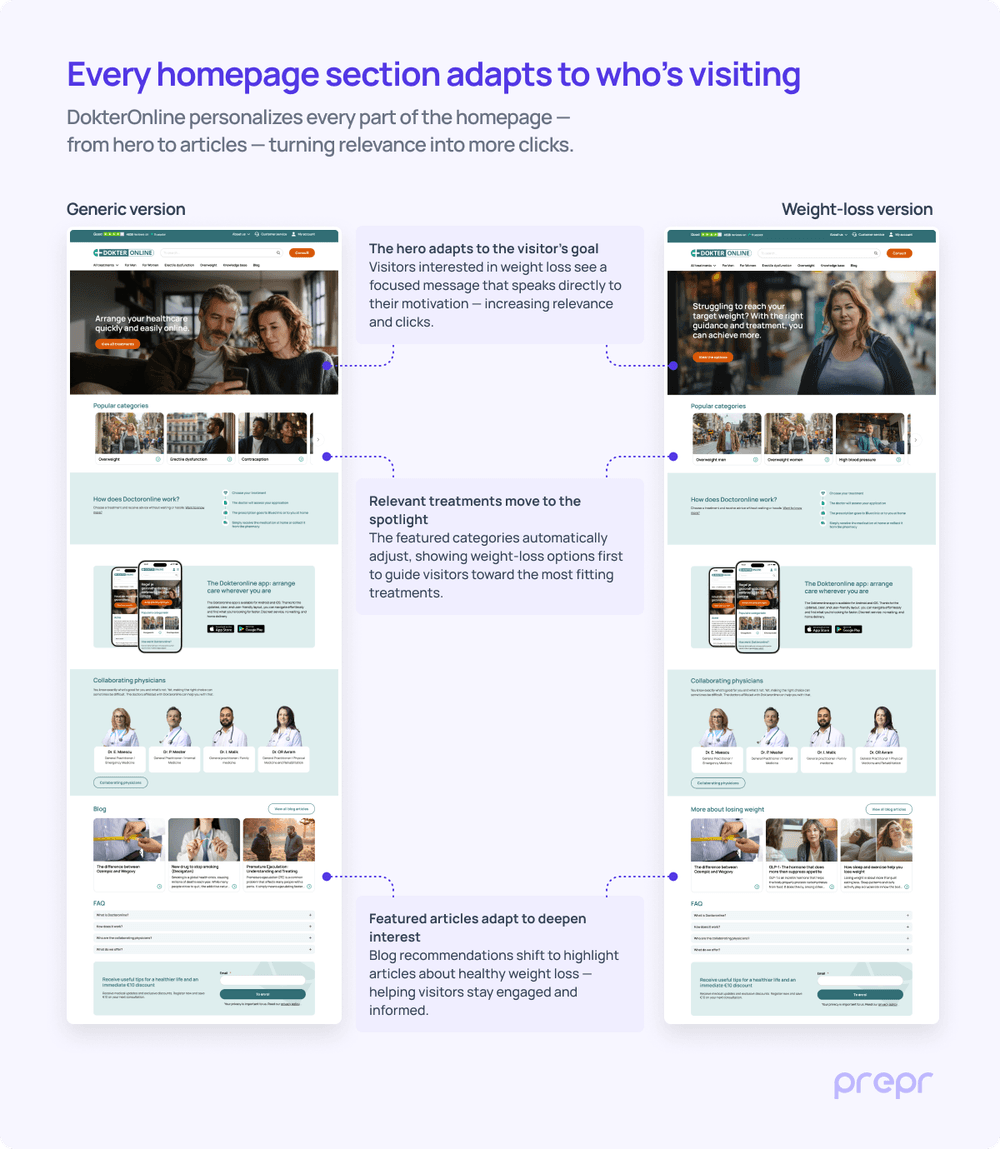
The website itself remains the same. Only a small number of homepage components are adapted to better match a visitor's interests.
This illustrates an important point: effective personalization doesn't necessarily come from large-scale changes. Small adjustments, applied at the right moments, can already have a meaningful impact on how visitors engage with a website.
What starting small actually looks like: The DokterOnline approach
DokterOnline, an international e-health platform, helps people access medical advice and treatments for a range of sensitive health conditions. Their visitors don't browse casually. They arrive with specific questions about weight loss, contraception, erectile dysfunction, or STIs, and they need to feel understood before they trust the platform with anything further.
When the team looked at why engagement wasn't growing as expected, they found that visitors with very different intentions were all seeing the same homepage. Someone researching weight-loss treatments, for example, could be presented with a hero focused on an entirely different condition. The content itself wasn't the issue; the homepage simply didn't reflect the visitor's intent.
As Roxanne van Hassel, Conversion Specialist at DokterOnline, puts it: "People don't decide to order medication online just like that. Relevance builds trust, and trust drives decisions."
The solution was straightforward. They defined five behavioral segments based on the conditions visitors showed interest in. Rather than relying on demographic data or purchase history, the segmentation was based on the pages people explored. From there, they adapted a small number of homepage elements for each segment: the hero image, featured treatments, and the articles that appeared first.
Using Prepr, the team could manage these segments and content variants within the same content environment, allowing them to personalize selected parts of the homepage without creating separate experiences or adding another tool to the stack.
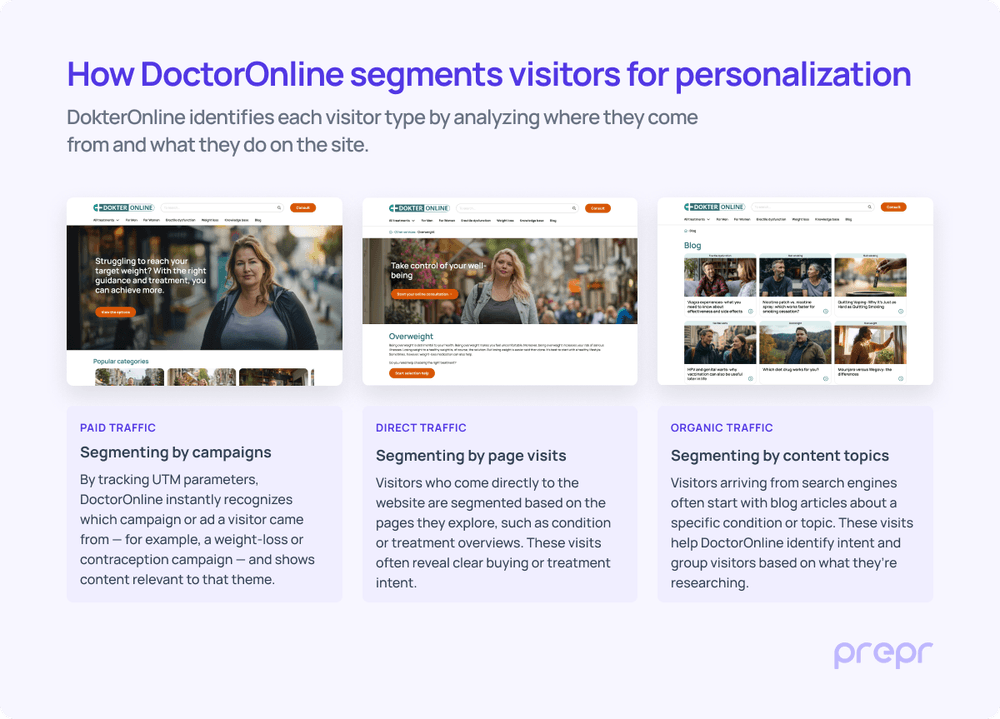
The focus was not on creating entirely different experiences. The structure of the website remained the same. The goal was simply to make the first experience more relevant by giving greater visibility to the content most closely aligned with a visitor's interests.
No sensitive data was used, and no major infrastructure was required. The content team could manage and update the variants themselves while maintaining a consistent medical tone across every version.
What happened when they made the switch
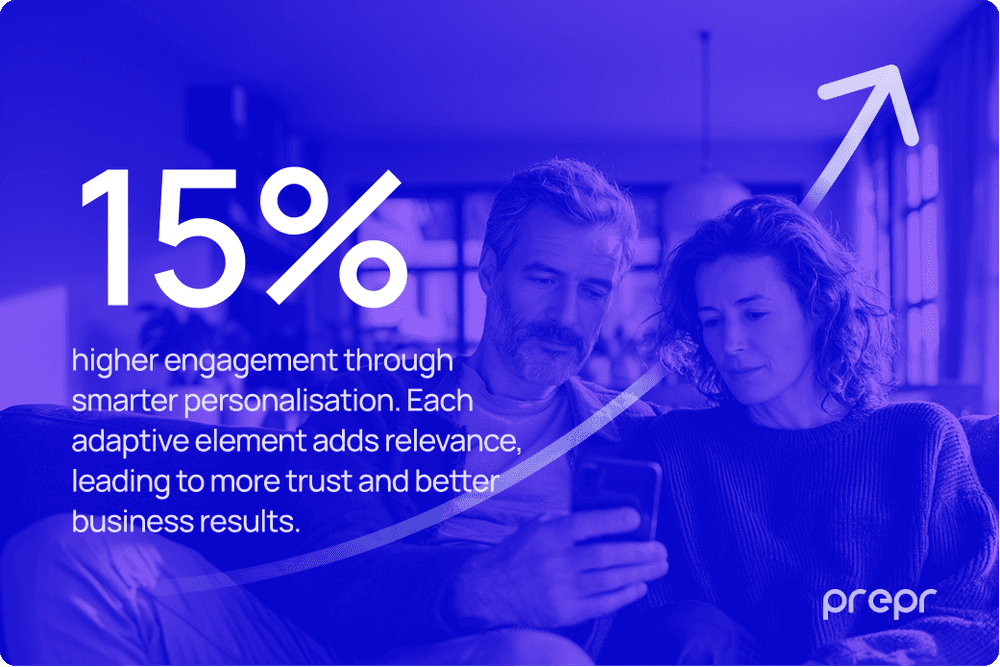
After introducing a more adaptive homepage experience, DokterOnline saw engagement increase by more than 15%. Visitors spent more time exploring the website, interacted more frequently with personalized content, and viewed more pages during their sessions.
Some of the strongest improvements were seen in the homepage components that adapted to visitor interests. Click-through rates on personalized content increased by an average of 83%, suggesting that visitors were more likely to continue exploring when the experience reflected the topics they were already interested in.
The results also provided a broader insight into visitor behavior.
In healthcare, engagement is closely linked to trust. People often need time to read, compare information, and understand their options before making a decision. Making the homepage more relevant helped visitors find information that matched their interests and encouraged them to continue exploring.
The team also found that tactics commonly used in e-commerce did not necessarily translate to a healthcare context. Visitors responded better to clear, relevant information than to strong product promotion.
What other organizations can learn from the DokterOnline experience
The DokterOnline case shows that personalization doesn't have to begin with a platform migration or a large data project. It can start with a single page, a handful of behavioral signals, and a few carefully chosen adaptations.
For many organizations, the first step is identifying where visitors arrive with different intentions but are presented with the same experience. That could be the homepage, a product category, or a landing page. The starting point matters less than taking a practical first step.
As visitor expectations continue to evolve, successful personalization is not necessarily driven by the largest budgets or the most advanced technology. Often, it starts with understanding visitor intent, testing small improvements, and building on what proves effective.
That principle is also reflected in how we've built Prepr, with personalization directly integrated into the CMS. Content, behavioral data, segmentation, and experimentation come together in one environment, making it easier for teams to start small, learn what works, and expand from there.
The average visitor doesn't exist. Recognizing that is often the first step toward creating more relevant digital experiences.