Mid-market B2B companies are stuck in the middle
B2B commerce has changed dramatically over the past few years.
Today's buyers expect the same convenience they experience as consumers. They want to research products independently, access account-specific information, place orders online, and move seamlessly between digital channels and their account manager.
For many mid-market B2B companies, delivering that experience is easier said than done.
Traditional commerce platforms often lack the flexibility to support modern buying journeys. At the other end of the spectrum, fully composable architectures offer enormous freedom but often require the budgets, engineering capacity, and implementation timelines of large enterprises.
That leaves many organizations in an uncomfortable position. They know their digital experience needs to evolve, but the available technology often feels like a choice between two extremes.
The real challenge, however, isn't choosing the right platform. It's dealing with a commerce landscape where systems, data, and customer experiences have become disconnected.
We believe that's the problem mid-market B2B companies need to solve first.
Three signs your commerce stack is working against you
Disconnected systems create friction throughout the customer journey. While every organization is different, the symptoms are remarkably similar.
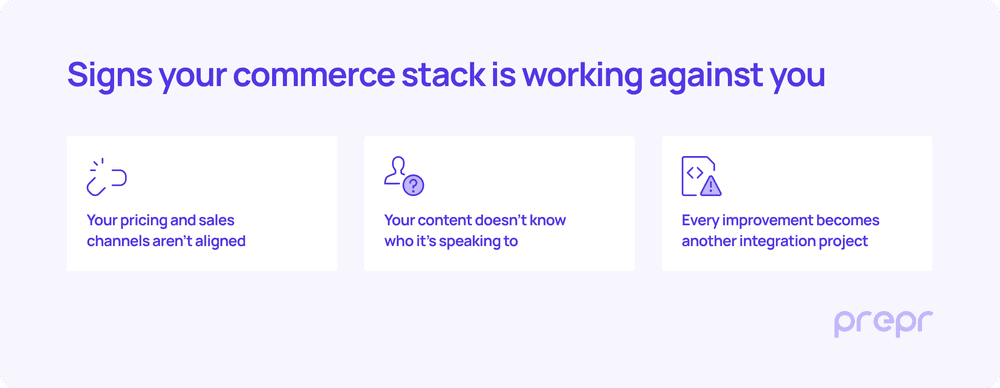
1. Your pricing and sales channels aren't aligned
Most B2B companies already have sophisticated commercial agreements in place. Customers have negotiated pricing, account-specific assortments, discounts, and payment terms.
The problem is that this information doesn't always make it into the digital experience.
Imagine a wholesale distributor where a customer logs into the webshop expecting to see their negotiated prices, only to find standard list prices instead. They call their account manager, who immediately sees the correct pricing in the ERP system. The relationship hasn't changed, but the digital experience doesn't reflect it.
When pricing, product availability, and customer agreements aren't connected across systems, buyers receive inconsistent information depending on which channel they use.
2. Your content doesn't know who it's speaking to
B2B buying decisions involve different people with different information needs.
An engineer wants technical specifications. A procurement manager needs contract information. A service technician looks for installation documentation. A purchasing team wants product availability and pricing.
Yet many B2B websites present exactly the same content to everyone.
The reason is rarely a lack of content. It's that customer data, content, and commerce logic live in separate systems that don't communicate effectively.
Without those connections, personalization becomes difficult, and every visitor receives the same generic experience regardless of their role, account, or relationship with the business.
3. Every improvement becomes another integration project
As businesses grow, so does the technology stack.
A CMS manages content. A commerce platform handles transactions. An ERP stores pricing and inventory. Customer information lives in the CRM. Personalization is added through another platform. Search requires another integration.
Individually, each tool solves an important problem.
Together, they often create a new one.
Every new feature requires integrations, synchronization, testing, and ongoing maintenance. Instead of improving the customer experience, teams spend their time connecting systems and resolving dependencies.
The stack becomes increasingly difficult to evolve, slowing down innovation instead of enabling it.
Why existing approaches don't fully solve the problem
Many organizations respond by upgrading their commerce platform or moving toward composable commerce.
Both approaches have clear advantages, but they also come with trade-offs.
Traditional commerce suites offer simplicity but can become restrictive as business requirements evolve. Customizing experiences, introducing new channels, or adapting content often means working within the limitations of a single platform.
Fully composable architectures offer maximum flexibility, allowing organizations to select best-of-breed solutions for every capability. For large enterprises with dedicated architecture teams, this can be the right approach.
For many mid-market companies, however, the operational reality is different.
They need the flexibility to support complex B2B workflows without creating an ecosystem that's expensive to build, difficult to maintain, or dependent on continuous integration work.
Rather than choosing between rigidity and complexity, many organizations need a third option.
Introducing the Connected Commerce Stack
We call that approach the Connected Commerce Stack.
A Connected Commerce Stack is a commerce architecture designed specifically for mid-market B2B organizations. Instead of trying to make one platform do everything, it clearly separates operational commerce from the digital experience while ensuring the two continuously work together.
It consists of two connected layers.
The commerce layer manages everything that makes B2B commerce unique: product catalogs, customer-specific pricing, account agreements, inventory, transactions, and the coordination between online and offline sales.
The experience layer manages everything customers interact with: content, personalization, digital journeys, landing pages, campaigns, and omnichannel experiences.
Separating these responsibilities allows each layer to do what it does best.
Connecting them ensures that customer data, product information, pricing, and content work together to create a consistent buying experience.
Instead of forcing businesses to choose between flexibility and manageability, a Connected Commerce Stack delivers both.
How Propeller and Prepr bring this architecture to life
The collaboration between Propeller and Prepr is an example of how a Connected Commerce Stack works in practice.
Propeller provides the commerce foundation. It manages the operational complexity behind B2B commerce, including product information, customer-specific pricing, account logic, ordering processes, and the coordination between digital and traditional sales channels.
Prepr provides the experience layer. It enables marketing and digital teams to manage content, personalize experiences, and create customer journeys without disrupting the underlying commerce logic.
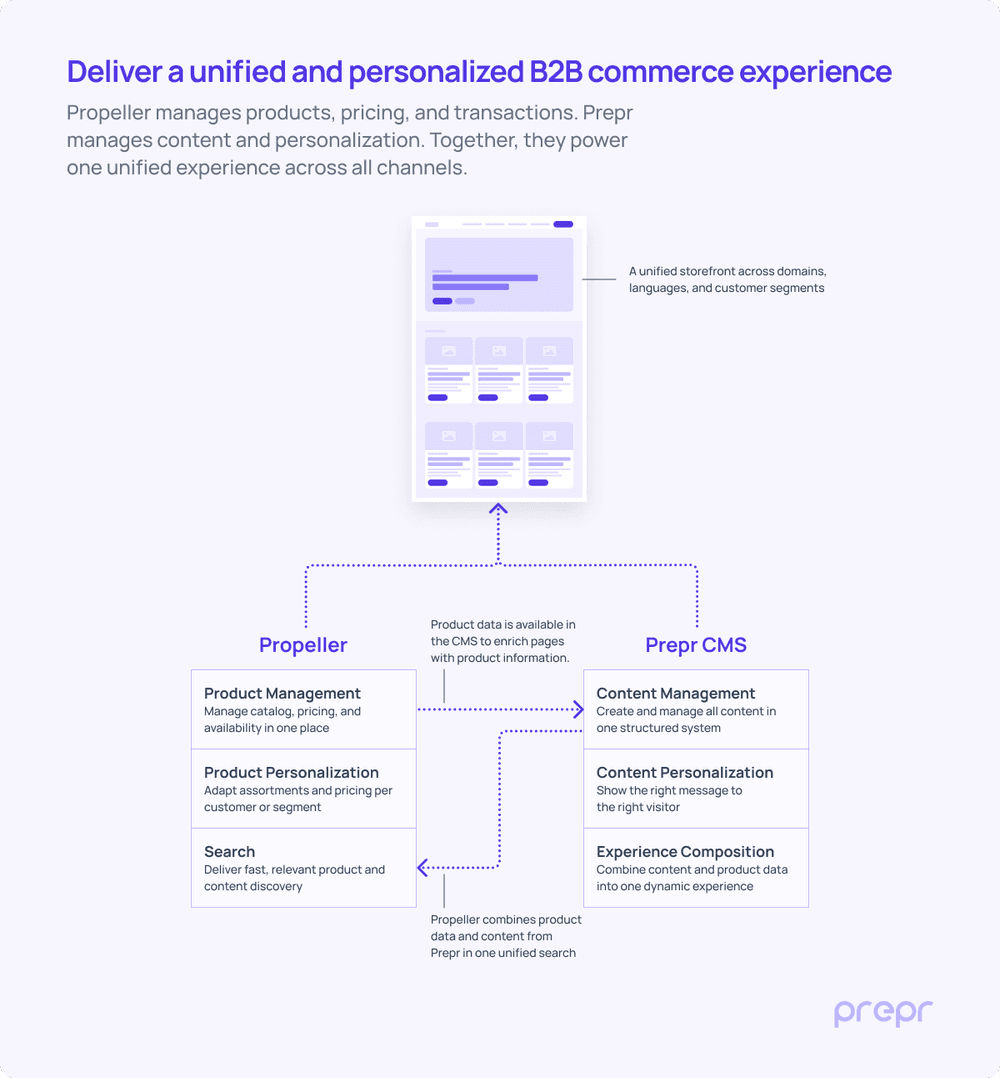
Because both layers work together, businesses can deliver experiences that reflect the actual relationship they have with each customer.
A returning customer automatically sees the right pricing, relevant products, and content tailored to their account. Marketing teams can launch new campaigns without changing commerce workflows. Sales teams and digital channels stay aligned because they're working from the same connected foundation.
Rather than adding more technology, the Connected Commerce Stack helps existing technology work together more effectively.
What this enables for mid-market B2B companies
Connecting commerce and experience creates tangible business outcomes.
Organizations can deliver consistent pricing and product information across every sales channel. Content becomes more relevant because it reflects who the customer is, not just what page they're visiting.
Marketing teams can build new landing pages, campaigns, and personalized experiences without relying on lengthy development projects. Commerce teams retain control over pricing, catalog management, and operational processes without slowing down digital innovation.
Most importantly, businesses gain an architecture that can evolve over time.
Instead of rebuilding the entire platform every few years, they can improve individual parts of the stack while maintaining a connected customer experience.
The future of B2B commerce is connected
Mid-market B2B companies don't need fewer capabilities. They need better connections between the capabilities they already have.
As customer expectations continue to evolve, success will depend less on having the biggest technology stack and more on creating one where commerce, content, customer data, and sales channels work together seamlessly.
That's what a Connected Commerce Stack is designed to achieve.
For organizations looking to modernize their digital commerce experience without taking on enterprise-scale complexity, it offers a practical path forward: one that delivers the flexibility to grow while remaining manageable for the teams that use it every day.