

With thousands of specialists across strategy, design, technology, and marketing, iO is one of the largest digital agencies in Europe. The agency works on a wide range of digital platforms, from relatively simple content-driven websites to complex digital ecosystems for large corporate clients.
As client expectations evolve, so does the technology behind their digital platforms. Many organizations are moving toward composable architectures that offer greater flexibility, scalability, and higher performance over time.
For large enterprise programs, these architectures are already common. But for mid-sized digital projects, the equation is different. They want the same flexibility and future-proof architecture, yet their digital projects rarely justify the complexity, tooling overhead, and licensing costs of enterprise-grade stacks.
A missing layer in iO’s stack for mid-sized digital projects
iO has a strong enterprise proposition. For large organizations running complex digital programs, the agency designs and delivers sophisticated composable architectures supported by best-of-breed platforms.
However, many client projects fall outside this enterprise segment. These mid-sized digital projects often focus on lead generation and e-commerce websites, where success depends on attracting visitors, converting them into leads or customers, and continuously improving performance through personalization and optimization.
While clients increasingly expect these platforms to be built on modern composable architectures, the reality of mid-sized projects is different. Large composable stacks often require multiple specialized tools, integrations, and vendor contracts, significantly increasing implementation effort as well as operational costs and complexity.
This created a structural gap in iO’s stack. Enterprise platforms offered the flexibility and scalability clients expected, but often came with significant complexity and cost. More traditional CMS solutions were easier to position commercially, yet did not always support the level of flexibility and performance modern digital platforms require.
As a result, iO lacked a clear and repeatable approach for delivering composable platforms for mid-sized digital projects.
A headless CMS that enables lean composable architectures
iO addressed this gap by introducing Prepr as the CMS at the center of its composable stack.
Prepr combines content management, personalization, and experimentation in one headless CMS, allowing iO to build lean composable architectures that integrate naturally into the broader martech stack.
By consolidating capabilities that would normally require multiple tools, Prepr reduces both architectural complexity and the number of licenses typically required in composable setups.
As a result, teams can deliver flexible digital platforms while keeping implementations manageable and commercially viable for mid-sized digital projects.
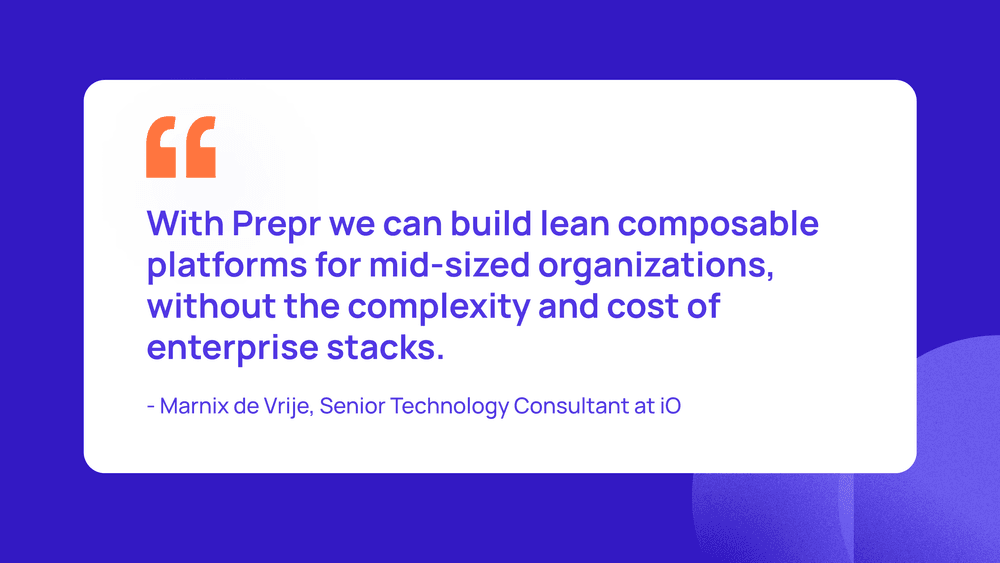
Strengthening iO's proposition for mid-sized digital platforms
The impact of the partnership is most visible in how iO positions and delivers digital platforms for mid-sized organizations.
With Prepr as part of its stack, the agency can now offer a clear, composable approach for lead generation and commerce platforms in this segment.
This makes it easier to scope and deliver projects with a predictable balance between flexibility, complexity, and cost. Clients gain the benefits of modern composable architecture, while implementation remains aligned with the scale and budget of mid-sized digital initiatives.
For iO, this clarity also strengthens commercial conversations. The agency can position a modern, composable solution that delivers enterprise-level capabilities at a price point and complexity level that makes sense for mid-sized projects. This makes it easier to stand out in competitive pitches and demonstrate clear value for money.
As a result, iO can confidently address a segment of the market that previously required difficult trade-offs between flexibility, complexity, and cost.
For iO, the partnership with Prepr reflects a broader shift in how digital platforms are designed and delivered for mid-sized projects. As composable architectures mature, many agencies are discovering that simpler composable stacks often deliver the best balance between flexibility, complexity, and cost.
At the same time, content management is evolving toward data-driven platforms that enable personalization, experimentation, and continuous optimization. In this direction, iO sees a strong strategic alignment with Prepr, combining modern headless architecture with the capabilities required to build and improve digital experiences over time.