

Recent research suggests that the agency market is entering a new growth phase. The SoDA Agency Outlook Study 2026 reports that 73% of agencies expected revenue growth in 2025, with nearly half projecting increases of more than 10%. Looking ahead, 92% of agency leaders forecast growth in 2026, and 84% say they feel optimistic about overall business performance.
After the intense digital acceleration during the COVID years and the market adjustments that followed, the industry appears to be stabilizing.
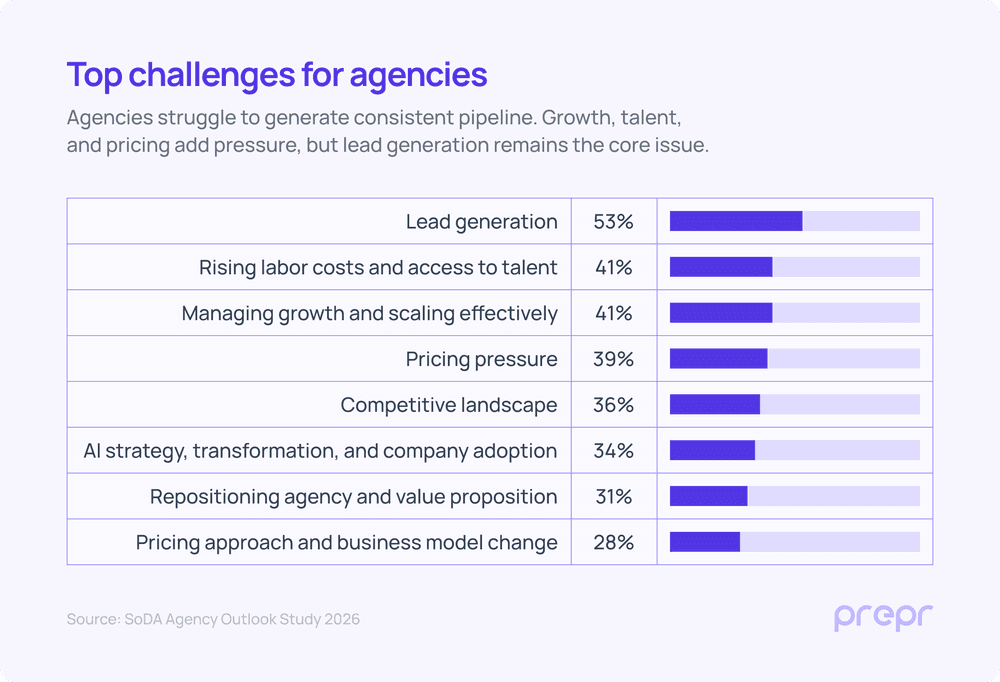
But growth does not mean the environment has become easier. Lead generation, pricing pressure, longer sales cycles, and rising acquisition costs remain major concerns for agency leaders.
At the same time, the agency model itself is changing. Many operational marketing tasks are becoming automated, clients expect agencies to demonstrate measurable business impact, privacy regulation is tightening, technology stacks are becoming more complex, and AI is moving from experimentation into everyday workflows.
In other words, agencies may be entering a period of renewed growth, but the conditions for competing successfully are evolving.
The five focus areas shaping digital agencies
Across the research reviewed for this article, five areas consistently emerge where digital agencies are adapting their capabilities and business models.
This article focuses on five practical priorities:
- AI adoption
- Strategic positioning
- Client acquisition and lead generation
- Martech stack decisions
- First-party data and governance
Together, these areas highlight where agencies are spending their resources as the market enters its next phase.
1. AI adoption: moving from experimentation to operational capability
Artificial intelligence is quickly becoming part of everyday agency operations. Today, more than 80% of agencies already use AI for creative ideation and over 70% rely on it to automate operational tasks, showing how quickly these tools have moved from experimentation into production workflows. Generative AI is accelerating content production and personalization, allowing agencies to produce more variations, test ideas faster, and deliver more personalized experiences.
But simply adopting AI tools does not create a competitive advantage. As these technologies become widely accessible, the real differentiator is how they are integrated into agency workflows and services. Agencies are beginning to redesign offerings around AI capabilities, while clients increasingly want to understand how these systems are governed, not whether AI is used, but how outputs are reviewed, validated, and responsibly integrated into campaigns and digital experiences.
This shift is also reshaping how agencies operate. AI is influencing pricing models, production processes, and the roles agencies need in their teams. At the same time, the effectiveness of AI depends heavily on the quality of marketing data. Without structured data and clear governance, AI struggles to produce reliable insights, even if it can generate content at scale.
2. Execution is no longer enough. Agencies are expected to think strategically
As AI and marketing platforms continue to automate operational tasks, the value of execution alone is declining. Campaign design, targeting, and optimization are increasingly handled by technology, reducing the need for agencies focused purely on delivery. As a result, agencies are expected to contribute at a more strategic level.
This shift is changing how agencies create value. Instead of executing campaigns, agencies are expected to help clients understand what actions to take, why they matter, and what business impact they will generate. Increasingly, this means connecting marketing activity to revenue, growth, and broader customer strategy. In this model, agencies move closer to decision-making and long-term planning, taking on a more active role in shaping business outcomes.
At the same time, agencies are expanding beyond traditional services. Many are developing technology-driven offerings, combining strategy, execution, and managed solutions into more integrated models. Clients are also evaluating agencies more directly on measurable impact , from conversion improvements to return on marketing investment. In this context, the most valuable capabilities are increasingly human: judgment, creativity, and the ability to translate data into decisions.
3. Client acquisition is becoming less predictable and more strategic
While the agency market is growing again, attracting and converting new clients is becoming more difficult. More than half of agencies report longer sales cycles, and nearly half say customer acquisition costs are increasing, making growth less predictable than before.
In response, agencies are investing more in their own sales and marketing capabilities. Instead of relying on referrals or a single acquisition channel, many are building more structured and repeatable approaches to lead generation. Agencies with defined acquisition processes consistently outperform those relying on ad hoc efforts, as they can generate a more stable pipeline and reduce dependency on unpredictable opportunities.
This shift is also changing how agencies approach growth. Multi-channel strategies are becoming standard, combining inbound marketing, targeted outbound outreach, partnerships, and industry visibility. At the same time, agencies are using their own data to improve targeting and personalize outreach, increasing conversion rates and long-term client value. Different positioning strategies can support this approach, from specialized agencies focusing on a specific niche to more integrated models covering the full customer journey, but in both cases, the ability to build a predictable pipeline is becoming a key differentiator.
4. Managing martech stack complexity without losing flexibility
Modern digital marketing increasingly depends on complex technology ecosystems. Delivering digital experiences now often requires integrating multiple tools across content, data, personalization, and analytics, which raises the level of technical expertise agencies need to support clients.
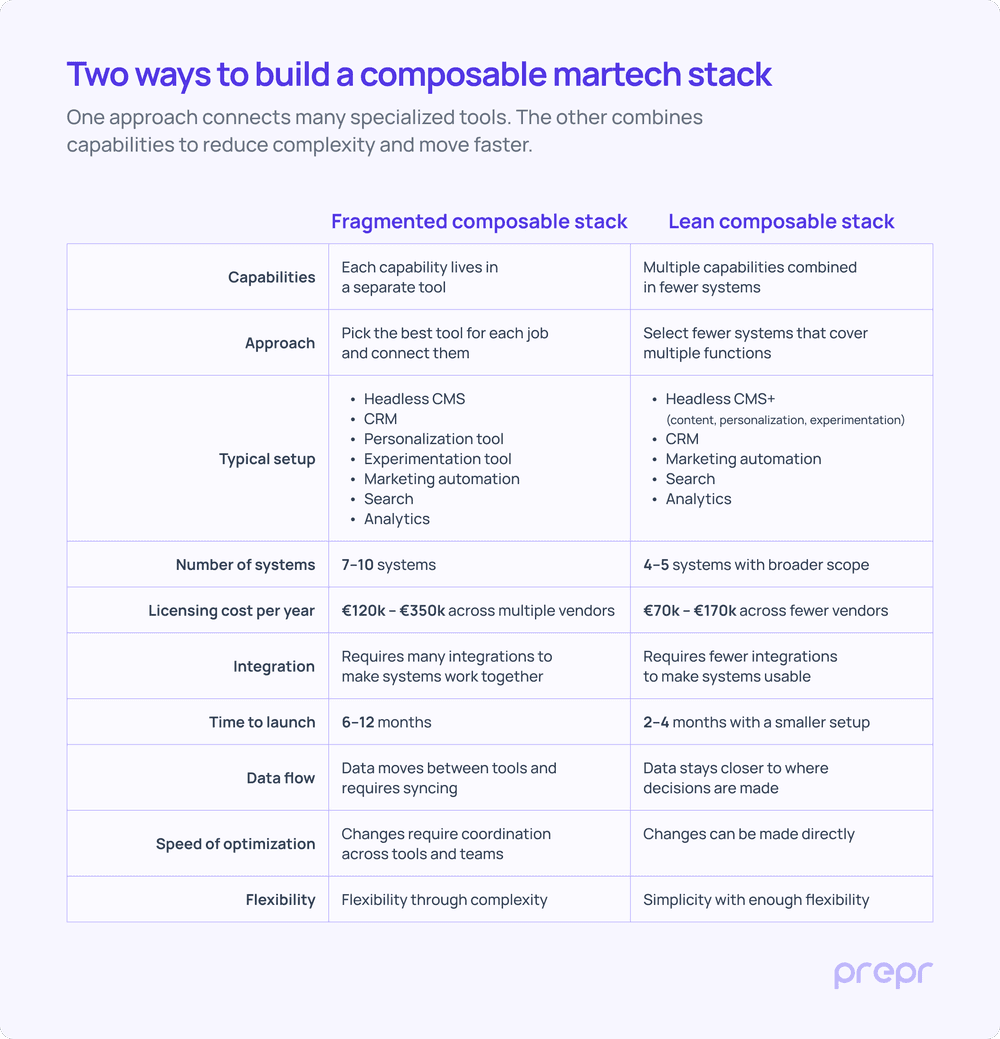
Composable architectures have made it easier to combine best-of-breed tools and adapt technology stacks over time. This flexibility allows organizations to select systems based on their specific needs rather than relying on a single platform.
This approach works well for enterprise organizations that have the budget and resources to manage multiple systems. But for mid-market clients, these setups are often too complex and too expensive to maintain. This creates a challenge for agencies, which want to build flexible, headless solutions but need to keep projects practical and affordable.
As stacks grow, they become harder to manage. Integrations and dependencies add complexity, slowing down delivery and increasing maintenance effort. In practice, many agencies are now facing these limits. When too many tools are combined, teams often spend more time managing integrations than delivering marketing outcomes. As a result, clients are increasingly looking for leaner architectures that are easier to implement and more affordable.
5. First-party data is becoming the foundation of marketing
Changes in privacy regulation and tracking technology are forcing companies to rethink how marketing data is collected and used. As third-party cookies become less reliable, organizations are increasingly dependent on data collected directly from their own audiences, making first-party data a central asset for marketing.
This shift is not only technical but operational. Companies need to adopt more transparent, consent-based approaches to data collection and ensure that data is managed securely and in compliance with evolving regulations. As a result, agencies are expected to support clients not only with marketing execution but also with data governance, consent management, and compliance.
Increasingly, this also includes responsibility for how data is stored, accessed, and protected across platforms and third-party tools. In parallel, agencies are seeing growing demand for European-based solutions, as clients look for more control over data storage and reduce dependency on non-European providers.
At the same time, first-party data is not only about compliance, but also about performance. Strong data foundations enable better targeting, more relevant personalization, and improved customer insights. As agencies take a more central role in managing platforms and data flows, they also become part of the broader responsibility for protecting customer data within complex digital ecosystems.
Why digital agencies need to rethink how they create value
The agency market is growing again, but the conditions for competing are changing. Execution is becoming easier to automate, while expectations around strategy, data, and measurable impact continue to increase.
The agencies that will stand out are those that adapt their role, strengthen their acquisition models, simplify their technology choices, and build solid data foundations. Not by adding more complexity, but by making clearer decisions about where they create value.
For many agencies, the question is no longer whether to evolve, but how quickly they can adapt to remain competitive.