

The way people discover information is changing rapidly.
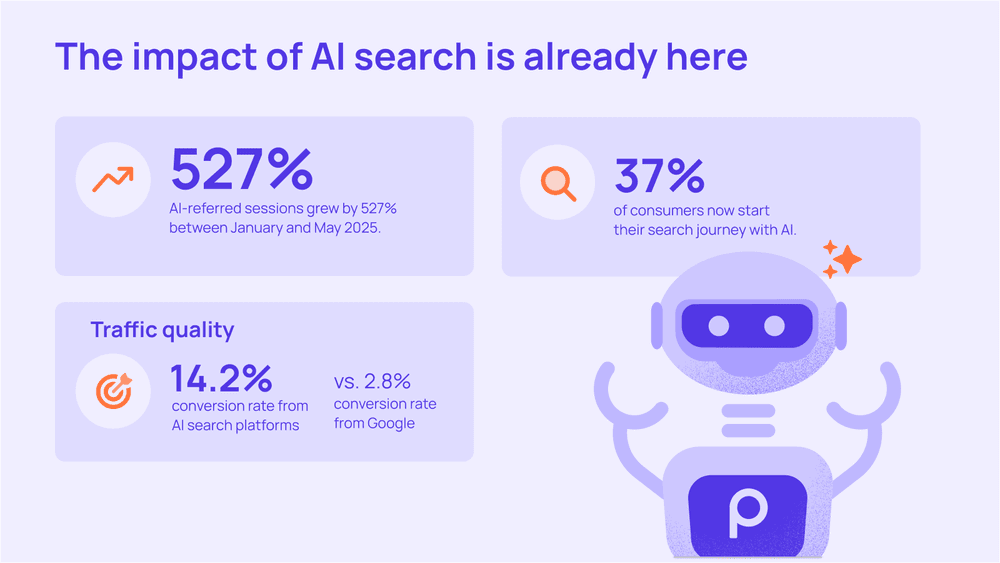
AI-referred sessions grew by 527% between January and May 2025, while 37% of consumers now start their search journey with AI rather than a traditional search engine (Search Engine Land). What's particularly interesting for marketers is the quality of this traffic. Traffic from AI search platforms converts at 14.2%, compared to 2.8% from Google (Position Digital).
For years, content marketers have focused on improving rankings, increasing organic traffic, and earning visibility in search engines. Keywords, backlinks, metadata, and internal linking all served the same objective: helping content appear when someone searched for an answer.
That objective hasn't changed, but the way people discover information is evolving.
Today, more people are turning to tools like ChatGPT, Claude, Gemini, Perplexity, and AI-powered search experiences to research products, compare solutions, and find answers to complex questions. Instead of scrolling through a page of links, users increasingly receive a synthesized answer generated from multiple sources.
For content teams, this introduces a new reality. It's no longer enough for content to be discoverable. It also needs to be credible, relevant, and structured in a way that makes it likely to be referenced when AI platforms generate answers.
What is GEO and how does it differ from SEO and AEO?
Generative Engine Optimization (GEO) is the practice of increasing the likelihood that your content is referenced when AI platforms generate answers. As tools like ChatGPT or Gemini become part of the discovery journey, understanding GEO requires distinguishing it from two closely related disciplines: SEO and AEO.
- SEO, or Search Engine Optimization, focuses on helping pages rank in search results and attract clicks from users searching on platforms like Google and Bing.
- AEO, or Answer Engine Optimization, focuses on helping content appear as a direct answer to a user's question. Rather than encouraging someone to click through to a page, the goal is to provide a concise response that search engines or AI assistants can surface immediately.
- GEO addresses a different challenge. Instead of optimizing for rankings or answer boxes, it focuses on making content more likely to be cited, referenced, or used as a source when AI systems generate a response.
The distinction is subtle but important. AEO aims to make your content become the answer. GEO aims to make your content become one of the sources behind the answer.
A page can rank highly in Google and still never appear in a ChatGPT response. Likewise, a source that is frequently referenced by AI systems isn't always the page occupying the top position in traditional search results.
The good news is that these disciplines are not competing with one another. Strong content, clear structure, credible sources, and topical authority support SEO, AEO, and GEO alike.
How GEO changes the way visibility is measured
Most content marketers are used to measuring visibility through rankings, clicks, and organic traffic. GEO introduces another question: are AI platforms mentioning your brand when people ask questions related to your category?
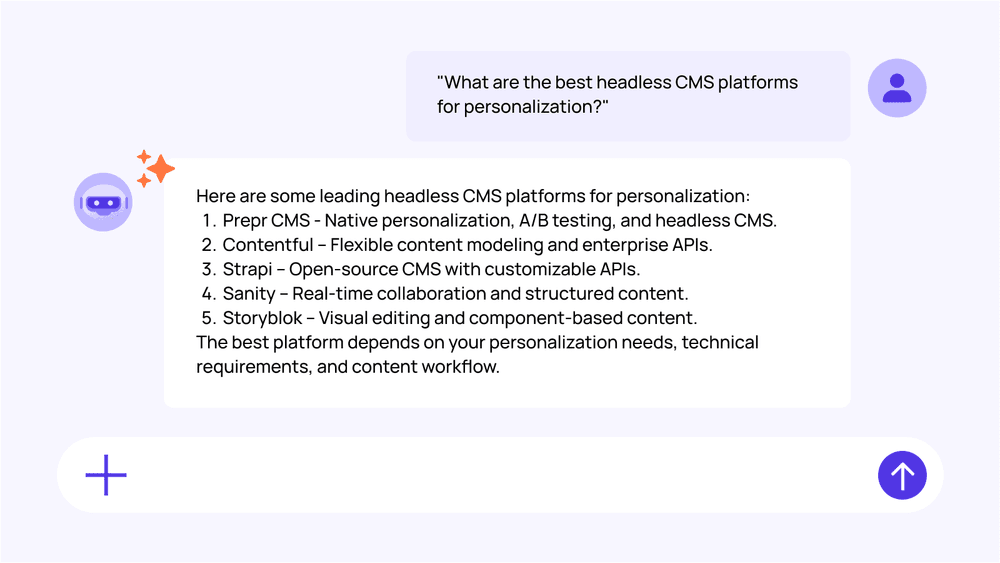
Consider someone evaluating different headless CMS platforms. They might ask: "What are the best headless CMS platforms for personalization?" The answer might mention three or four vendors, include a short comparison, and reference a handful of sources. If your brand isn't mentioned, you've lost visibility in that interaction, regardless of where you rank in Google.
This is why GEO introduces a different set of metrics.
One of the most useful is Share of Model Voice (SOMV). The concept is simple: out of a set of prompts relevant to your business, how often does your brand appear in the answers generated by AI platforms?
For example, if you analyze 100 prompts related to your market and your brand appears in 28 of the resulting responses, your Share of Model Voice is 28%.
To measure this, start by creating a list of prompts that reflect the questions buyers ask when researching solutions in your category. A headless CMS vendor, for example, might track prompts such as "What are the best headless CMS platforms?", "Which CMS is best for personalization?", or "What are the best Contentful alternatives?". Running these prompts regularly across platforms such as ChatGPT, Gemini, and Perplexity can help you track which brands appear, how often they are mentioned, and which sources are cited.
Citation frequency is another useful indicator. It measures how often your content, website, or brand is referenced when AI systems generate answers. While rankings show where you appear in search results, citations reveal whether AI platforms consider your content trustworthy enough to use as a source.
This doesn't replace traditional SEO metrics. Rankings, traffic, and conversions still matter. GEO simply adds another layer of visibility measurement, one that reflects how often your brand becomes part of the answer itself.
Build authority before optimization
Authority sits at the center of GEO.
Research from First Page Sage found that domains with more than 32,000 referring domains were 3.5 times more likely to be cited by ChatGPT. The exact number is less important than the broader takeaway: authority remains one of the strongest predictors of visibility in AI-generated answers.
AI platforms don't treat all sources equally. They rely on signals that help them assess expertise, credibility, and relevance. In practice, that means authoritative websites have a significant advantage when it comes to being referenced in AI-generated responses.
This is one reason GEO shouldn't be treated as a separate activity from content marketing. The same signals that help build trust with readers often help build trust with AI systems as well.
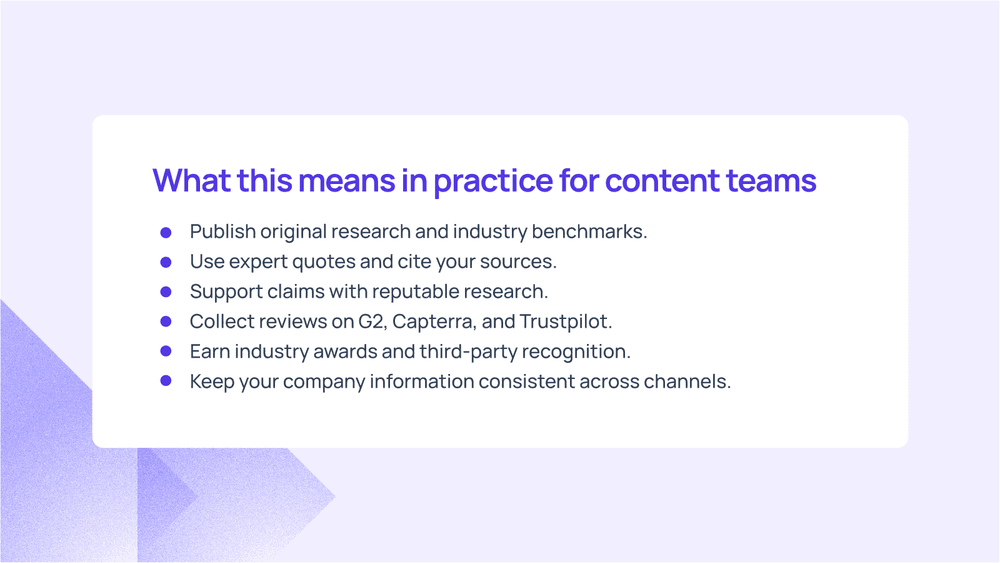
Original research is a good example. Companies that publish proprietary data, industry benchmarks, or unique insights create information that cannot easily be found elsewhere (GenerateMore.ai). That makes their content more valuable as a source.
The same principle applies to expert contributions. Quoting specialists, referencing reputable studies, and clearly attributing statistics all strengthen the credibility of a piece. They also make it easier for AI systems to understand where information comes from.
Authority also extends beyond the content itself. Reviews, awards, industry recognition, and mentions on trusted third-party websites all contribute to a brand's reputation. AI systems increasingly rely on these signals when evaluating which sources to surface and reference.
Before focusing on content formats or distribution tactics, it's worth asking a simpler question: if an AI platform is looking for the most trustworthy source on a topic, why should it choose yours?
How content structure influences AI visibility
One of the more interesting findings from recent GEO research is that the pages most frequently cited by AI platforms tend to look remarkably similar.
An analysis of 25,000 URLs by Evertune and Search Engine Land found that ChatGPT-cited articles shared a number of common characteristics. The median article contained 941 words, four H2 headings, two H3 headings, 15 external links, and 10 images.
That doesn't mean every article should follow the same template. It does suggest that AI systems favour content that is comprehensive, well-structured, and easy to navigate.
The way information is organised matters.
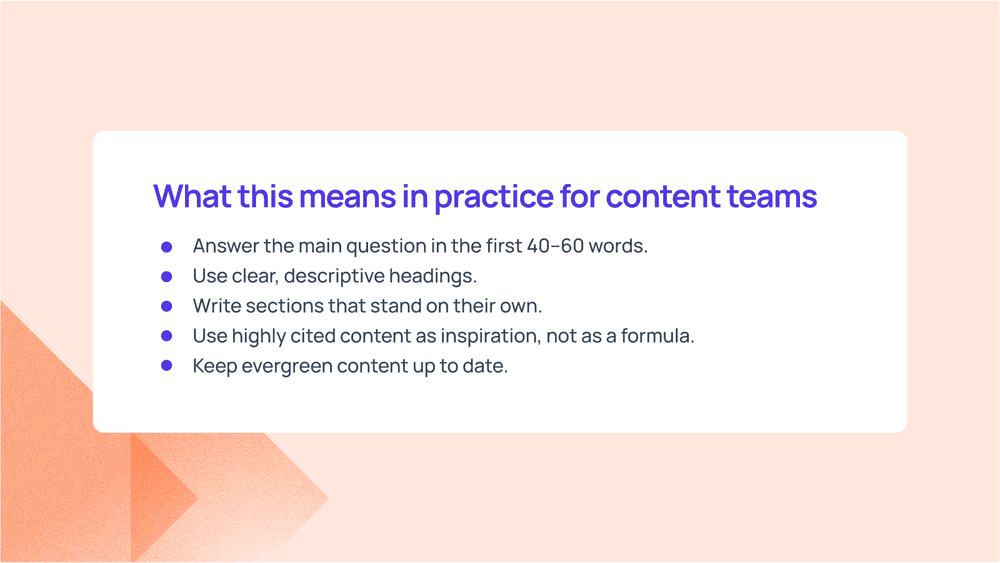
If the answer to a question is buried halfway through an article, both readers and AI systems have more work to do. The strongest-performing content tends to be direct. It answers the core question early, uses descriptive headings, and breaks complex topics into clearly defined sections.
Structure also matters at the paragraph level. AI systems often retrieve information in smaller passages rather than evaluating an entire article at once. Sections that can stand on their own are generally easier to interpret than content that relies heavily on references such as "as mentioned above" or "as discussed earlier."
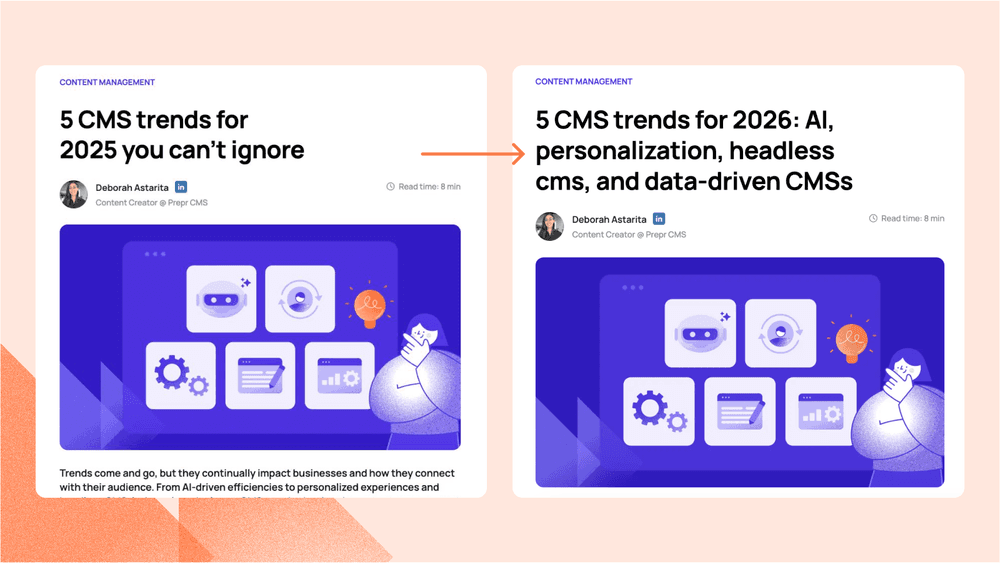
Freshness appears to play a role as well. For evergreen content, regularly updating statistics, examples, and industry developments can help maintain relevance over time. Some organisations are now adding dedicated update sections to important articles so readers and AI systems can quickly identify what's new.
We recently applied this approach to one of our own articles by refreshing the title, structure, examples, and content to reflect the latest CMS trends. Rather than publishing a new article, we kept the existing URL and updated it to remain relevant over time, an approach that benefits both readers and AI search. The comparison above shows how even small changes can help keep evergreen content current.
Which content formats perform best in AI search?
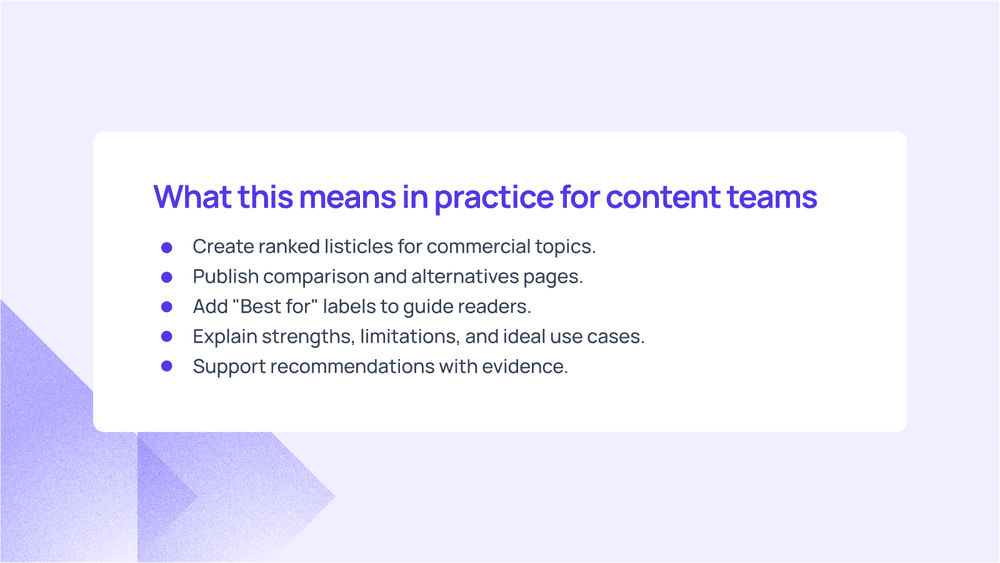
Research from Evertune and Search Engine Land found that 63% of citations across major AI platforms pointed to listicles. Most of those citations came from ranked lists rather than unstructured collections of recommendations.
The finding makes sense when you consider the types of questions people ask AI platforms. Users often look for recommendations, alternatives, comparisons, and evaluations before making a decision. Queries such as "best headless CMS platforms", "top personalization tools", or "Contentful alternatives" naturally lend themselves to ranked answers.
That doesn't mean every content strategy should revolve around listicles. Educational guides, research reports, and documentation remain important. But when the goal is visibility for commercial and product-related queries, comparison-driven content appears to have a clear advantage.
Comparison pages deserve particular attention. AI platforms frequently cite "X vs Y" articles, alternative pages, and buyer's guides when users are evaluating solutions (Search Engine Journal). These formats provide structured information that can be easily incorporated into generated answers.
Build visibility beyond your own website (91% of AI answers do)
AI platforms frequently rely on third-party sources when generating answers (Track My Visibility). Reviews, community discussions, industry publications, comparison sites, and social platforms all influence which brands are mentioned and referenced.
For marketers, visibility is no longer limited to owned channels. Publishing content remains important, but so does participating in the broader conversations happening across your industry.
Reddit is one of the most frequently cited sources for platforms such as ChatGPT and Perplexity (Medium). Discussions where users compare products, share experiences, or ask for recommendations often become part of the information AI systems reference when generating answers.
Industry publications, roundups, and expert recommendations can also influence visibility. Being included in a "Top 10" list on a respected website may have a greater impact on AI visibility than publishing another article on your own blog.
How to know if your GEO strategy is working
Unlike traditional SEO, there is no universal dashboard that shows exactly how often your content is being used by AI platforms. The ecosystem is still evolving, and many of the available metrics remain imperfect.
That doesn't mean GEO can't be measured.
Some of the most useful indicators include citation frequency, Share of Model Voice, AI referral traffic, branded search growth, and conversion rates from AI-generated traffic.
Referral traffic provides another useful signal. Tools such as GA4 can help identify visits originating from platforms like ChatGPT, Perplexity, and other AI-powered search experiences. Over time, this data can help connect visibility to actual business outcomes.
It's also worth looking beyond traffic. The research suggests that AI-referred visitors often arrive with stronger intent than traditional search users. Monitoring engagement, lead generation, and conversion rates can therefore provide a more complete picture of GEO performance.
For teams just getting started, a simple manual audit can be surprisingly effective. Create a list of 10–20 prompts relevant to your category and run them regularly across the AI platforms that matter most to your audience. Track which brands appear, which sources are cited, and how your visibility changes over time.
GEO is still an emerging discipline, but the fundamentals are already clear. Brands that build authority, publish useful content, earn third-party validation, and structure information effectively are more likely to become part of AI-generated answers.
As AI search continues to grow, the goal is no longer just to rank; it is to become one of the sources behind the answer.