
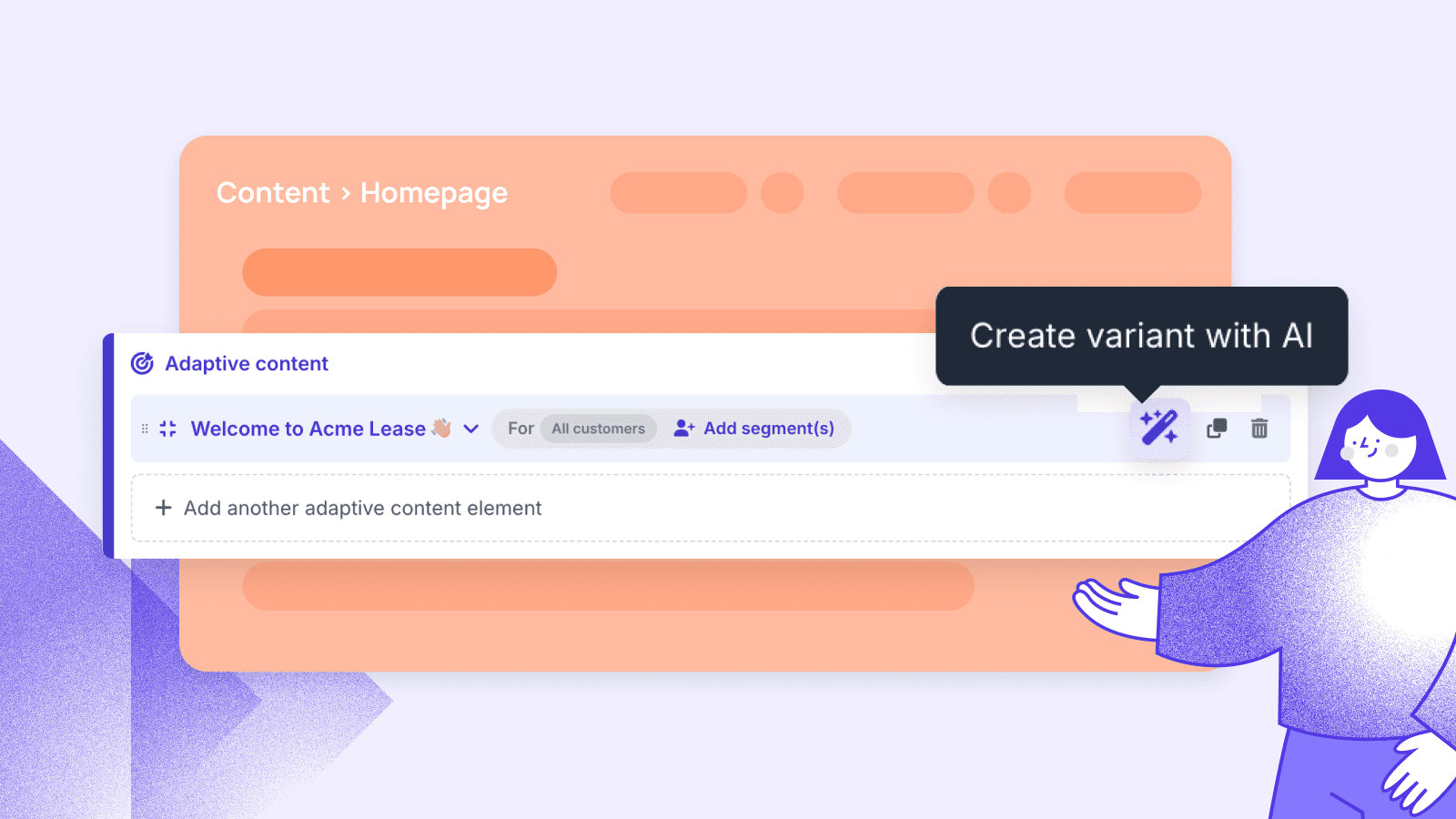
Over the past few years, personalization has moved from an experiment to an expectation. Industry surveys consistently show that more than 70% of consumers expect tailored experiences, and marketers agree that personalized messages outperform generic ones by a wide margin. As a result, most teams now segment their audiences, adjust their messaging, and try to speak more directly to different groups.
For many teams, personalization itself is no longer the hard part. Creating a main version of a page and adapting it for different audiences is already built into their strategy and workflows. What often determines success is how easily editors can explore different ideas and turn them into concrete variants.
Creating one version of a page is quick. Creating three or four versions for different segments naturally invites more decisions: what should change, what should stay consistent, and how each audience should be addressed. This is where editors often spend the most mental energy, not rewriting content, but finding the right angle for each group.
AI makes it easier to explore and create personalized variants
Instead of treating personalization variants as separate pieces of content that need to be rewritten from scratch, AI makes it possible to start from ideas rather than blank fields.
Over the past year, AI has found its way into many everyday tools, supporting tasks that once required long manual work. Writing assistance, translation, and text refinement are now common features in content software, and teams have grown comfortable using AI to speed up routine steps, generate suggestions, explore alternatives, and improve clarity without losing control over the final result.
With this shift, it becomes realistic to apply AI to adaptive content as well. AI can generate clear, structured text in seconds and provide a draft that already reflects the needs of a specific audience group. The editor keeps full control of the message, reviewing, adjusting, and refining, but no longer has to start from an empty field each time.
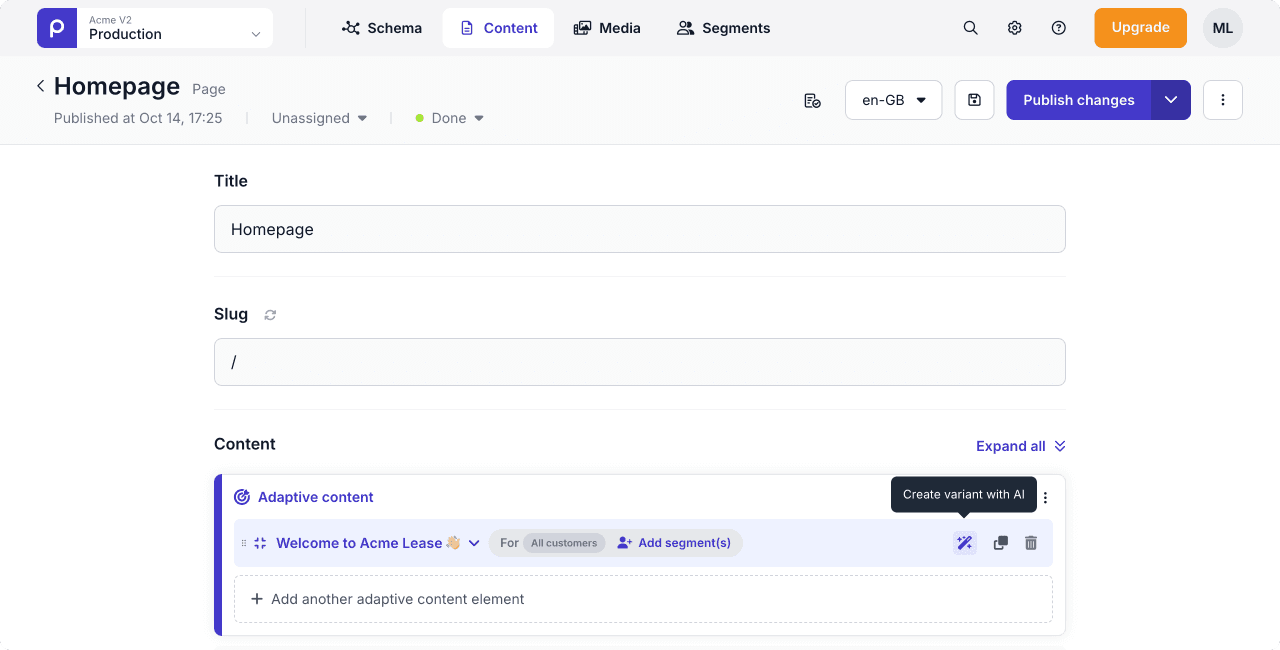
The default component version for all users. From here, editors can generate an AI-based variant for a specific audience.
In practical terms, AI supports the creative thinking behind personalization. It reduces the effort needed to explore alternatives, making it easier to experiment with different messages while keeping a clear connection to the original content.
As AI becomes a natural part of everyday content work, it creates space for CMSs to support personalization in a far more efficient way.
What the variant generation process looks like inside Prepr CMS
Prepr brings this idea directly into the editor.
When creating adaptive content, editors can add a new personalized variant, choose the segment they want to address, and ask Prepr to generate the first version of the message. The system produces a draft tailored to that audience, and the editor can refine it immediately. The generated variant is never created in isolation.
Prepr starts from the generic version of the content and combines it with the description of the selected audience segment. Editors can add contextual information to a segment, and AI uses that description to adapt the message while staying aligned with the original content.
Because of this, the structure and core message remain consistent, while the language and emphasis shift to better fit the audience being addressed.
Editors always remain in control of the content. They can compare the generated variant with the source text to see what changed, and they can edit every part of the suggestion before publishing. The feature helps with the first draft, but the final voice and direction stay with the team.
In the example below, the editor selects a segment, requests a generated variant, and Prepr fills the field with a draft they can refine. The editor never leaves the CMS, and the personalized version is created in seconds.
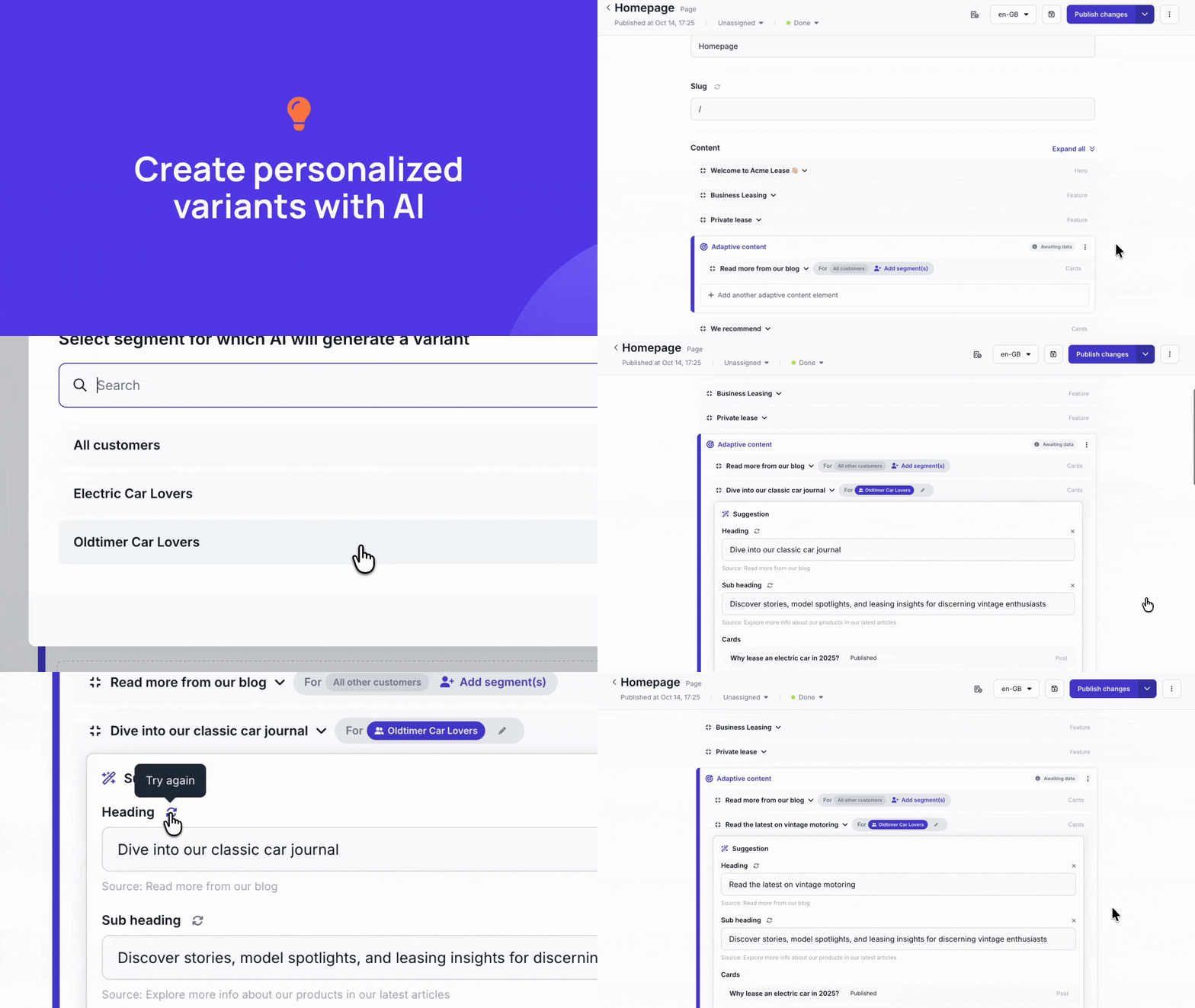
This simple interaction removes the repetitive steps that usually slow personalization down and makes it easier to produce several variants during the same session.
How AI-generated variants supports everyday editorial work
Automatically generated variants make personalization easier to apply in day-to-day work.
The benefit is immediate. Editors can create more variations without interrupting their flow, and because every variant starts from the same base content, consistency across segments is easier to maintain. Instead of rewriting similar messages, editors focus on improving clarity, tone, and relevance for each audience
Just as importantly, AI helps spark ideas. Editors can review different approaches side by side, combine elements from multiple suggestions, or adjust direction entirely. This makes personalization more flexible and encourages teams to refine and evolve their content over time.
This also opens the door to more frequent updates. When producing variants is faster, teams can adjust their personalized content as audience needs change, without committing to a full rewrite each time.
Part of a bigger direction: AI features built for everyday editorial work
This update builds on a direction Prepr has been following for some time: bringing intelligent assistance into everyday content work. Editors already use Prepr to generate first drafts, improve clarity, shorten text, create summaries, or translate full content items without leaving the CMS. They can also request suggested variants for experiments, helping teams test ideas more easily.
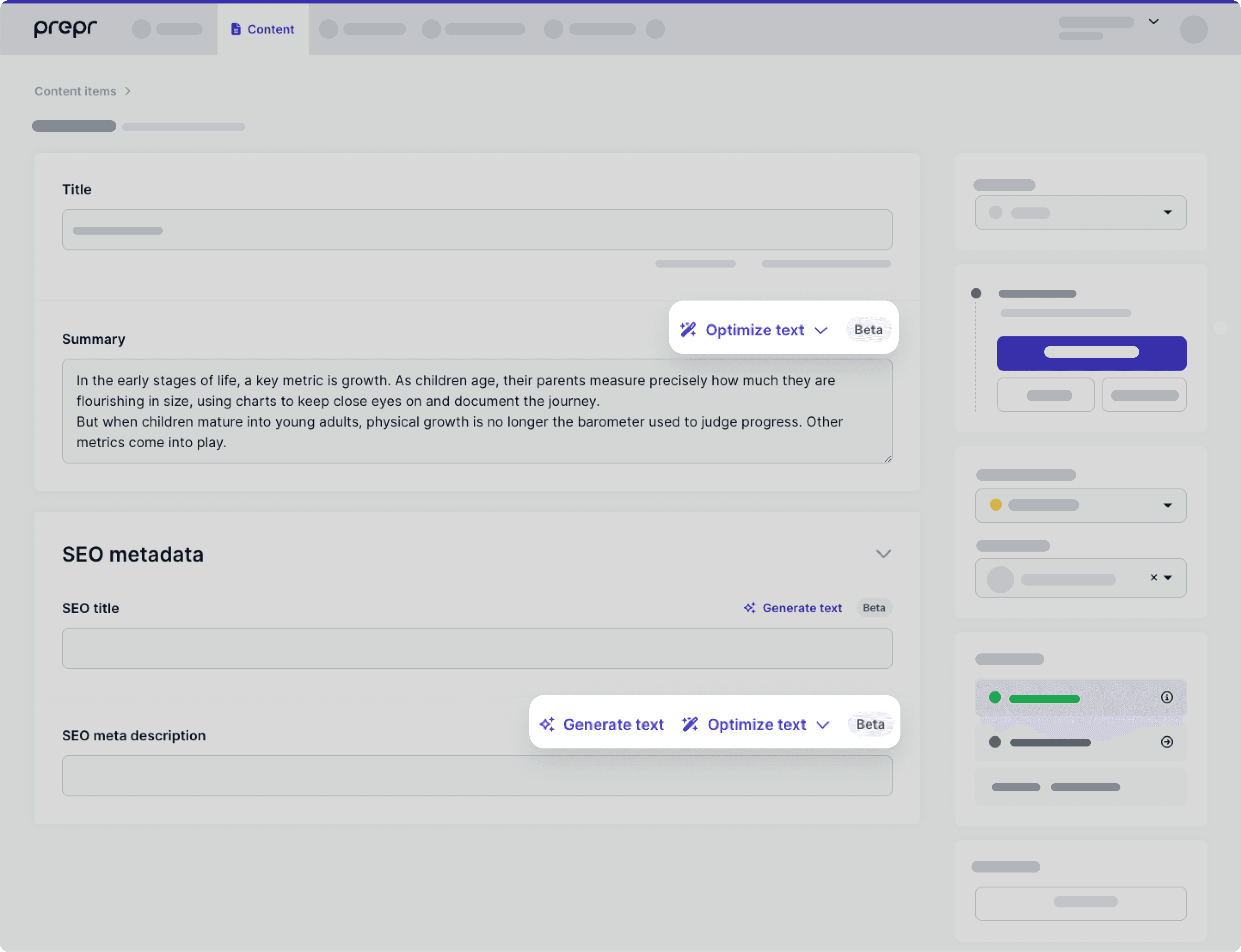
AI text generation and optimization tools inside Prepr CMS, available directly in content fields and SEO metadata.
The ability to generate personalized variants is another step in the same path. Instead of treating AI as an add-on, Prepr integrates it directly into the places where content production slows down. Each feature supports a specific task, writing, adapting, translating, or refining, so teams can work faster without compromising quality.
And more capabilities are on the way. In 2026, Prepr will add AI-generated image alt texts to support accessibility and SEO, as well as AI-assisted schema suggestions to help teams build strong content models with less trial and error.
Taken together, these developments mark the shift from a traditional content system to a CMS that actively assists teams throughout their workflow. Personalization becomes easier to scale, experiments become easier to launch, and everyday content work becomes lighter.
A CMS that helps shape content, not just publish it
Personalization has long been seen as a way to improve the customer experience, but it often requires extra effort from content teams. What is changing now is the role AI can play inside the tools teams use every day.
Automatically generated variants help reduce friction in the creative process, giving teams more room to focus on message clarity, creativity, and the decisions that shape a better experience. Editors can explore more ideas, update variants more often, and keep pace with audience expectations without extending their workload.
This is the direction modern content operations are moving toward: not more tools, but smarter ones. And a CMS that helps produce content, not just publish it, is becoming an essential part of that change.