

In the last few years, content has become the beating heart of how brands communicate. With ads being skipped, muted, or blocked, the only messages that truly reach people are the ones they choose to read. Companies now produce an endless stream of blog posts, videos, whitepapers, and guides to earn that attention. But in this flood of content, one uncomfortable truth keeps resurfacing: much of it simply isn’t very good.
The internet is drowning in content, 27 million pieces of it are created every single day. And yet, research shows that 60 to 70% of website content goes completely unused. Most of it never finds an audience, never ranks, and never supports the brand it was meant to represent.
In other words, we don’t have a content shortage; we have a quality shortage.
Poorly edited articles, broken links, missing metadata, and thin SEO all eat away at credibility. And when content fails to meet a basic level of quality, it doesn’t just disappoint readers, it undermines the brand itself. It’s the digital equivalent of handing someone a beautifully designed brochure with typos and half-empty pages.
In an environment where trust and authority are earned word by word, content quality isn’t a “nice to have.” It’s essential.
The quiet work that makes great content possible
Behind every piece of content worth reading, there’s usually an editor, someone who ensures that the story makes sense, that every link works, that titles and descriptions meet SEO standards, and that what gets published reflects the brand at its best. Editors are, in many ways, the last line of defense between a thoughtful piece of communication and another forgettable page on the internet.
But as content operations grow and the pressure to publish increases, maintaining that level of care becomes difficult. Deadlines are tight, content pipelines are full, and many editors find themselves spending more time tracking technical issues than shaping stories. The reality is that manual quality control doesn’t scale easily, and that’s where smart automation can help.
From volume to value: building a smarter quality control process
It’s easy to get caught up in publishing more. For years, content marketing rewarded frequency, the more you produced, the better your chances of being found. But the market has shifted. With millions of new posts appearing each day, producing “more” isn’t a strategy anymore.
You have to produce better.
Improving content quality requires attention to two levels:
- The editorial level, which ensures the story is meaningful, relevant, and well-written.
- The technical level, which ensures every piece meets structural and SEO standards — that fields are filled in, links are working, and the content can perform as intended once it’s live.
The first part is human craft. The second part can, and SHOULD, be automated.
If the challenge for content teams today is to do more with less, to uphold editorial standards while keeping pace with deadlines, then the solution lies in rethinking how we manage quality.
That’s where technology can step in to support, not replace, the editorial eye. Routine checks like verifying required fields, testing links, or reviewing SEO metadata don’t require creative judgment, but they do require time and attention.
At Prepr, we’ve always believed that great content experiences are built on a combination of creativity and precision. Our mission has been to help teams not just publish content faster, but publish it better. From collaborative editing to version control and personalized delivery, we’ve worked to make content operations more efficient without compromising on quality.
And now, we’re taking the next step in that direction.
Introducing Prepr’s Content Check

This is where our newest update, Prepr’s Content Check, comes in. It’s a new feature designed to make content quality control a natural, effortless part of the editorial process.
When activated, Content Check automatically reviews your content and provides feedback before publishing. It looks for the kinds of issues that are easy to miss when you’re focused on the bigger picture, such as:
- Missing required fields or fields exceeding the character limit
- Broken internal or external links
- SEO issues, such as missing titles, unoptimized descriptions, or opportunities to improve keyword usage
In other words, it’s like having a second set of eyes, one that never gets tired, distracted, or pressed for time. It runs quietly in the background, surfacing what needs attention and leaving the creative work to you.
How Prepr’s Content Check works in practice
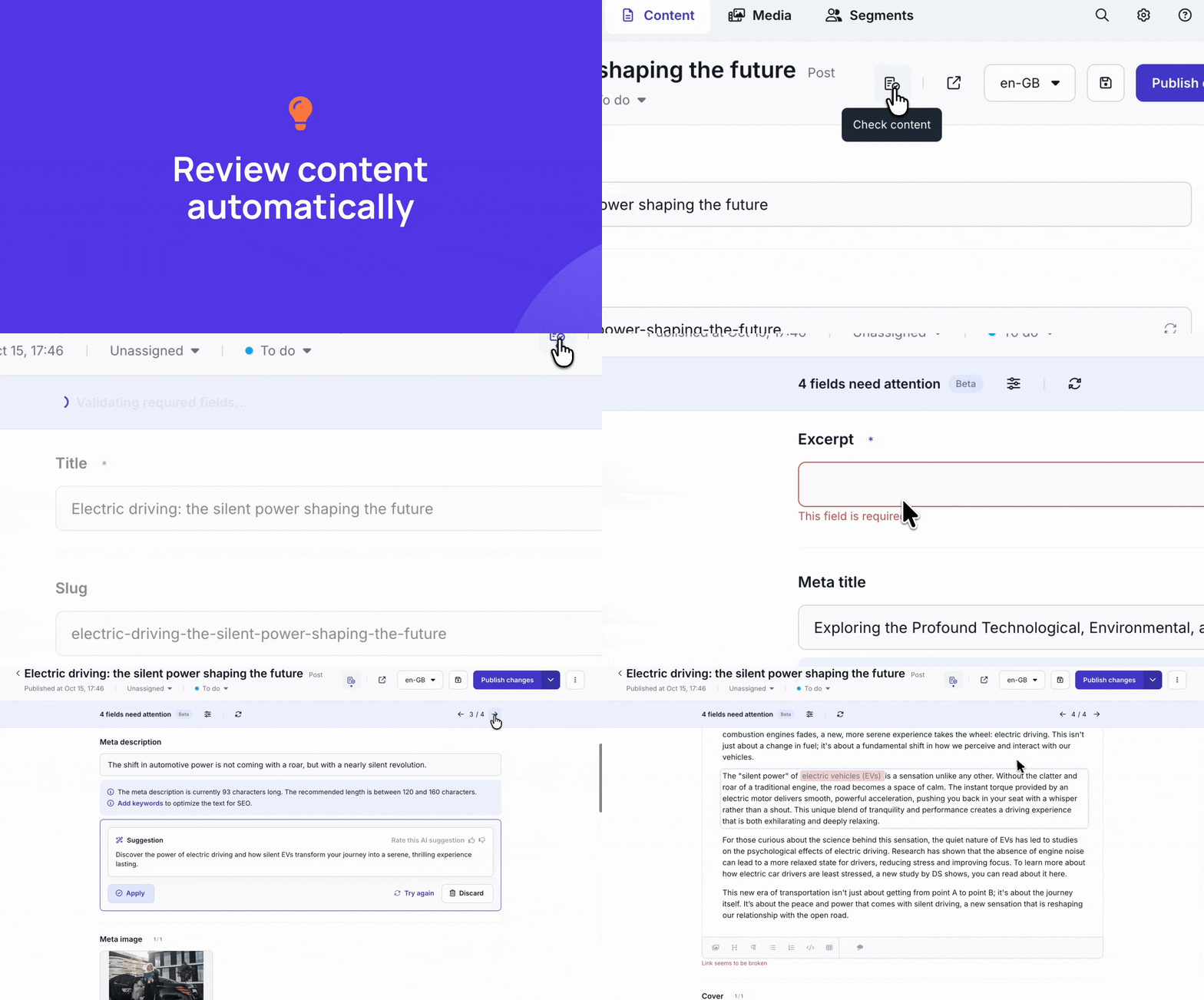
When you create or edit a content item, you can trigger the Content Check directly within the editor. In just one click, it runs a full scan and highlights any issues it finds.
For example, if a required field hasn’t been filled in, you’ll see a clear prompt to complete it. If a link is broken or leads to an unreachable page, you’ll get an alert. If your SEO settings aren’t fully optimized, perhaps a title is too short or the meta description doesn’t align with the focus keyword, the system will suggest improvements.
Each suggestion comes with context, not just a red mark, so editors understand why something needs to be fixed. It’s designed to assist, not dictate.
Keeping an eye on what needs attention
Quality control isn’t just about individual content items, it’s about having visibility across your entire content library. Even with the most organized workflows, things slip through, especially for editors managing dozens or hundreds of pieces.
That’s why we’ve also introduced Prepr’s Needs Attention view, a simple but powerful way to stay on top of content quality across your workspace. It acts as a centralized dashboard that automatically gathers every item flagged by the system for review, so you no longer have to hunt through content lists or rely on memory to find what needs fixing.
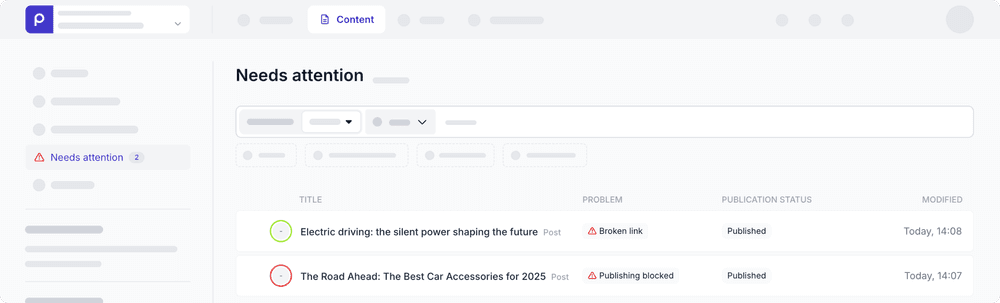
From this view, editors can immediately see which items have broken links or are not yet complete (for example, when the workflow stage isn’t set to Done). A quick click opens the item directly, allowing you to resolve the issue and publish the fix immediately. The process is clean, fast, and transparent.
Together, Prepr’s Content Check and Needs Attention form a system of quiet reliability, one that keeps quality visible, manageable, and easy to maintain, even as your content operations scale.
If you’d like to learn more about how Prepr’s Content Check and Needs Attention view work, including setup instructions and examples, you can find a detailed walkthrough in our Reviewing content guide in our documentation.
Raising the standard and what comes next
Launching the Content Check is just one step in a much larger journey for us. Quality has always been a moving target; what counts as “good” content evolves as quickly as the platforms, algorithms, and expectations around it. That’s why our vision isn’t just to automate checks, but to create a smarter editorial ecosystem that continuously helps teams produce better content with less friction.
Over the coming months, we’ll keep expanding the capabilities of Prepr’s Content Check. We’re exploring new types of validation and more advanced, context-aware suggestions powered by AI, features that don’t just find issues, but help you understand why something matters and how to improve it. We want the system to become a true partner in your editorial process, one that learns, adapts, and grows with your content strategy.
At Prepr, we believe the future of content isn’t about producing more. It’s about producing content that people actually want to read, content that works, performs, and reflects the care that went into creating it.
Prepr’s Content Check is our way of helping you get there: one smarter review, one stronger story, one better piece of content at a time.