

The CMS: The foundation of every martech stack
Digital teams have spent years searching for the ideal martech stack: flexible, powerful, and manageable in terms of cost and complexity. The CMS sits at the center of that stack. It's where content is managed, structured, and delivered. In many cases, it's already the layer where the digital experience begins.
Over time, teams have added specialized tools around this core, a DAM for assets, a dedicated search solution, and separate platforms for A/B testing and personalization.
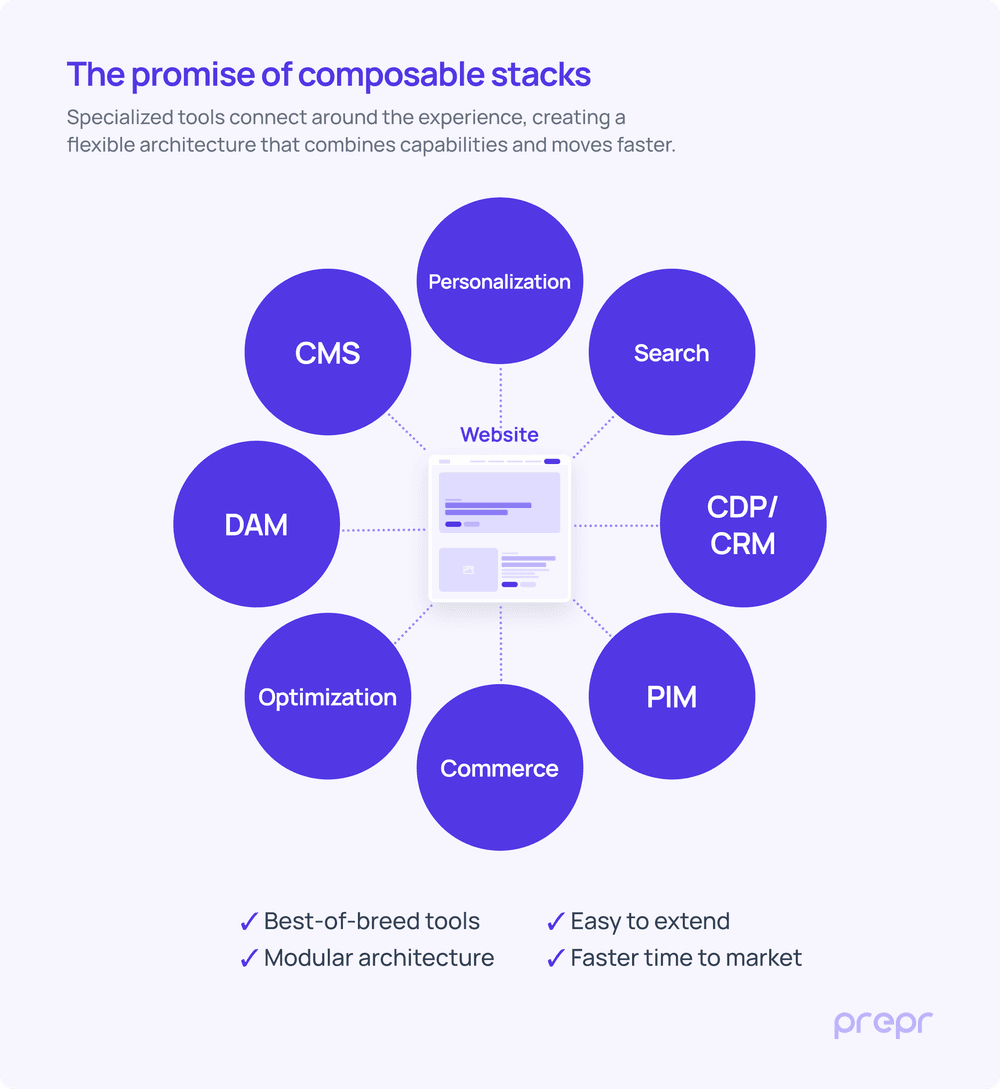
On paper, it's a strong model. Each system does what it does best, and together they form a flexible architecture. In practice, something else emerges: not just more flexibility, but more complexity. That's where the problems start.
Composable makes it complex
Composable architecture came with a clear promise: greater flexibility and faster innovation through best-of-breed tools. In practice, it often delivers the opposite.
The martech landscape grew to more than 14,000 tools in 2024. Yet, according to Gartner, teams use less than half of their stack on average, while budgets hold steady at around 7–8% of revenue.
As organizations combine more systems around the CMS, the complexity shifts to the integration layer between tools. Data needs to move across platforms, decisions are made in multiple systems, and performance becomes increasingly dependent on how everything works together.
In practice, this often leads to two patterns. Some organizations start ambitious personalization projects that turn out to be more complex and expensive than expected, causing delays or stalled implementations. Others postpone these initiatives altogether because the anticipated cost and complexity become barriers from the start.
In both cases, the impact falls short of expectations, not because of missing tooling, but because of the complexity created between systems.
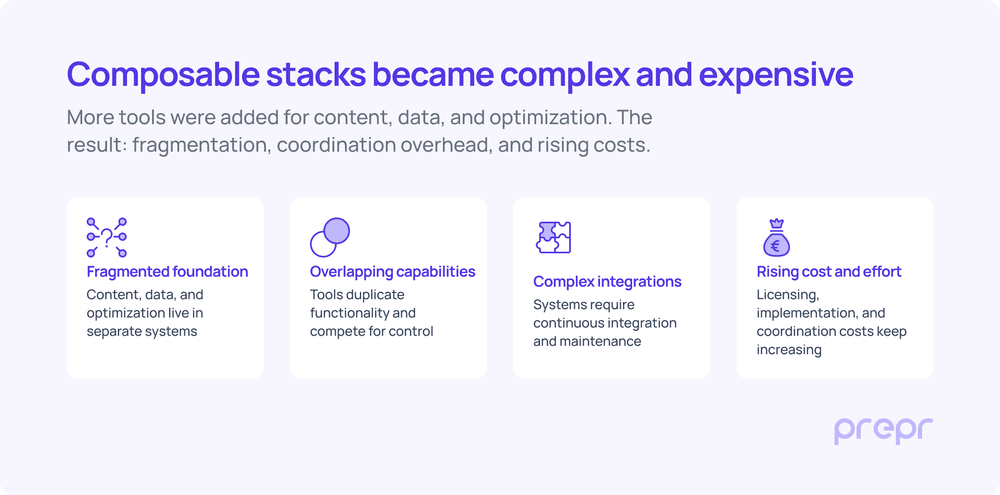
A stack combining a headless CMS, a CDP, a personalization engine, and an A/B testing platform looks clean in a diagram. In reality, it introduces a growing network of dependencies between systems.
As more tools are connected, changes in one part of the stack often affect multiple others. Optimization requires coordination across teams and platforms, while reaching a stable and effective setup can take several iterations.
This also shifts where the dependency lies. While composable architecture reduces vendor lock-in, organizations often become more dependent on the system integrator responsible for managing and connecting the stack.
The result is a setup that can be powerful and flexible, but also increasingly difficult to manage and optimize over time.
This tension is playing out openly across the industry. A CMSWire analysis of the MACH and composable architecture debate draws the same conclusion: composable has real value, but a fully best-of-breed model can produce fragmented workflows, higher costs, and mounting governance pressure. The debate isn't whether composable is right or wrong, but about finding the balance between flexibility and manageability.
The role of the CMS is shifting
At the same time, the market is clearly moving in response to this growing complexity. Platform vendors are expanding their systems to reduce the number of integrations required across the stack, particularly in the CMS space.
Where CMS platforms were once focused primarily on content management, they increasingly include capabilities such as personalization, A/B testing, search, and behavioral data. Functionality that previously required separate tools is gradually becoming part of the platform itself.
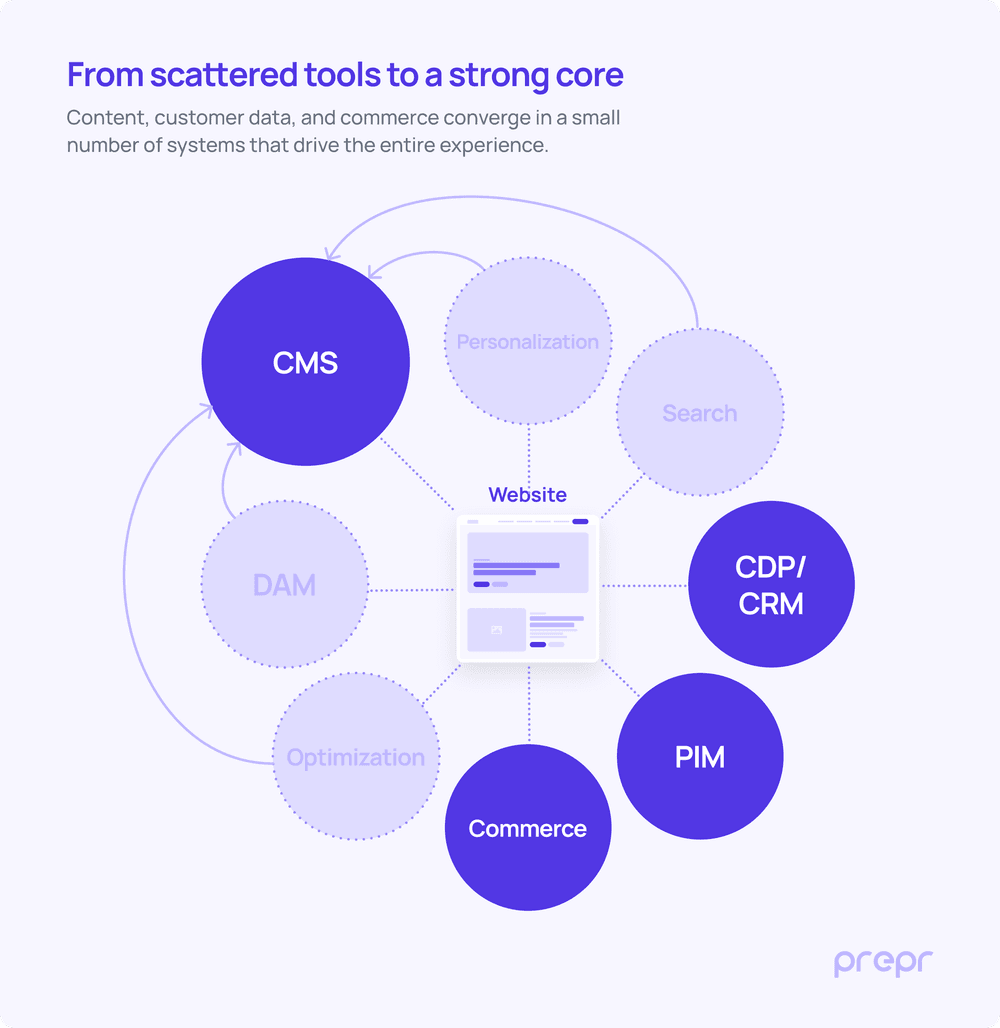
Forrester no longer describes CMSs solely as content management systems, but as platforms that help orchestrate digital experiences. By bringing content, delivery, personalization, and operational capabilities closer together, CMS platforms are taking on a more central role within the digital experience stack.
The main driver behind this shift is the complexity created between systems. When more capabilities are integrated directly into the CMS and delivery layer, the amount of coordination between separate tools decreases significantly. As a result, features that were once treated as add-ons increasingly become part of the core platform.
This changes the role of the CMS itself. Rather than only managing content, the CMS increasingly influences how content is delivered, personalized, tested, and optimized.
The stack gets smaller and clearer
This development is also changing how organizations structure their martech stack. Instead of relying on a large collection of specialized tools, many teams are moving toward a smaller number of core platforms with more clearly defined roles.
In practice, the stack is increasingly organized around three main domains: content and experience, customer data and segmentation, and commerce and transactions. Each has its own system and its own responsibility.
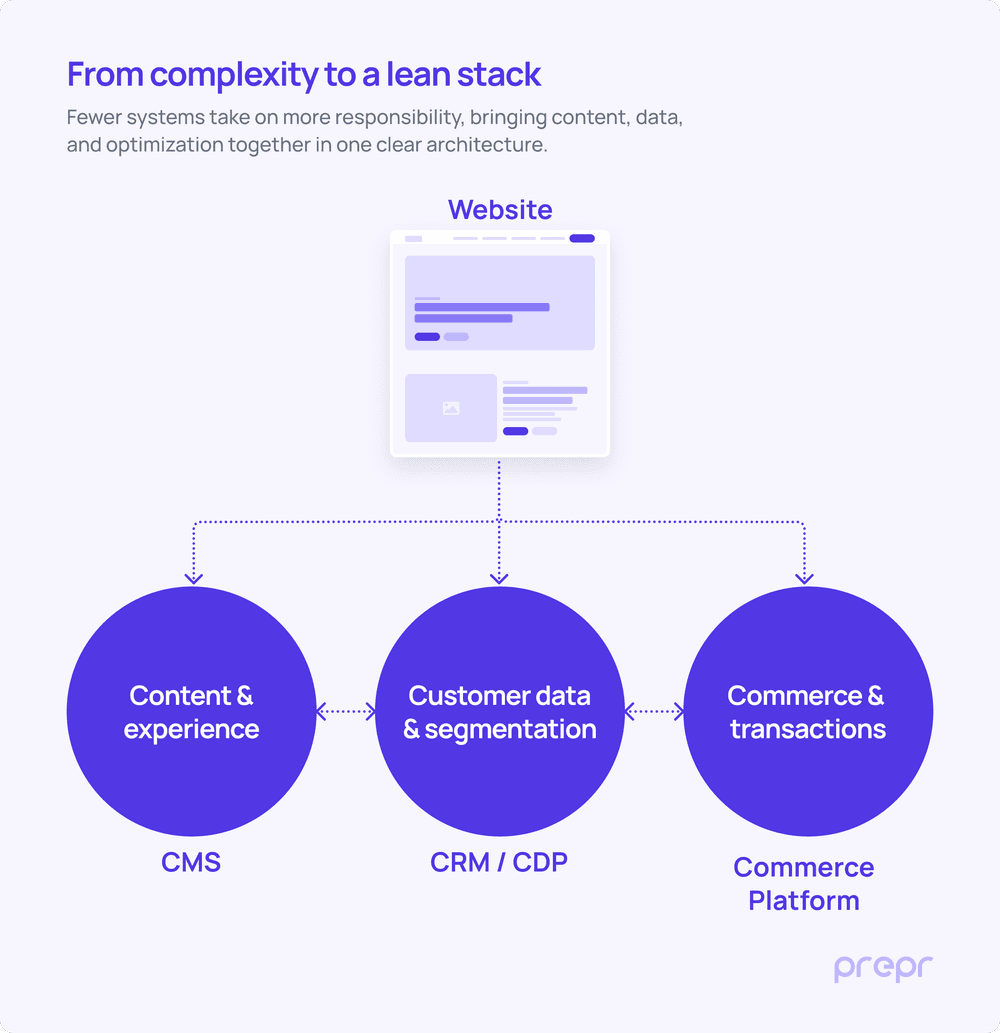
Within this setup, the CMS manages content and digital experience, while a CDP or CRM handles customer data and segmentation. Commerce platforms remain responsible for products, pricing, and transactions.
What is changing is the placement of capabilities such as DAM, search, personalization, and A/B testing. Rather than existing as separate products, these features are increasingly integrated into the core platforms themselves. They may not replace every standalone solution, but they are becoming sufficient for a growing number of use cases.
As a result, organizations can start with a smaller and more integrated foundation, and only add additional tooling when there is a clear need for it. This leads to a leaner stack with fewer dependencies between systems.
Fewer systems, less complexity, lower costs
A smaller stack doesn't just change the architecture. It changes how complex your organization needs to be.
With fewer systems involved, the number of integrations decreases and data needs to be synchronized less frequently across platforms. Decisions are made in fewer places, reducing much of the coordination overhead that typically develops between systems in larger stacks.
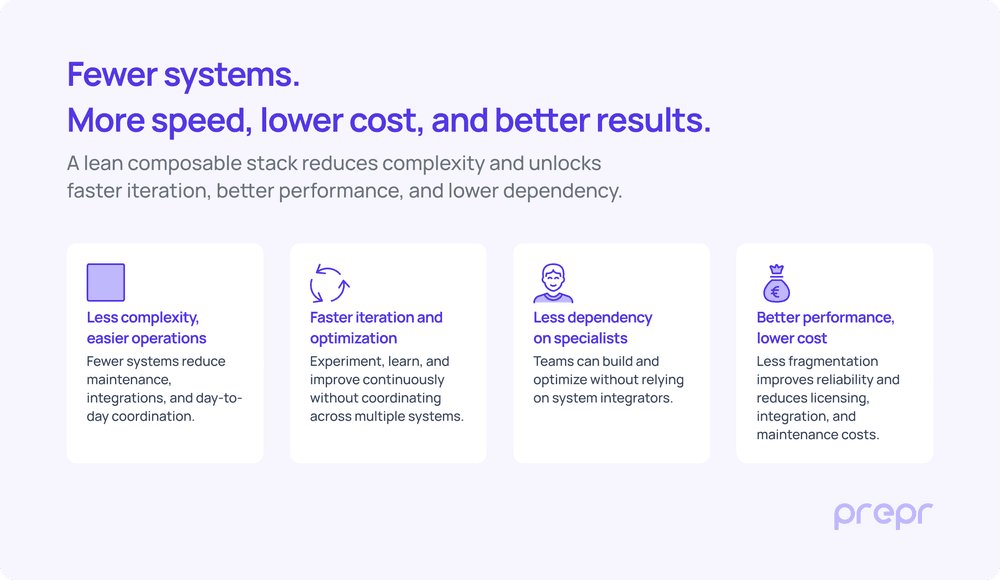
This has a direct impact on costs. While organizations may reduce licensing expenses, the bigger difference often comes from lower integration and maintenance effort. Fewer platforms mean fewer data flows, fewer dependencies, and less ongoing alignment work across teams and technologies.
The operational side becomes simpler as well. Teams rely on fewer specialized tools and require less external expertise to maintain the stack, which can help reduce long-term operational costs.
There are also advantages in terms of speed and optimization. When capabilities such as personalization and experimentation are integrated more closely with content and delivery, teams can iterate more quickly and launch changes with less coordination overhead. This makes continuous optimization easier to support in day-to-day operations.
Performance improves as well. In complex stacks, a single request can pass through multiple systems and API calls, introducing latency and instability. A tighter stack reduces that risk.
The result: a stack that's simpler to run, cheaper to maintain, and faster to improve.
Why is this shift happening now?
This isn't a trend that appeared from nowhere. Technology has matured. Cloud infrastructure and modern APIs make it practical to consolidate multiple capabilities into a single platform without sacrificing performance.
At the same time, processing and storing large volumes of behavioral data has become faster and more affordable. This makes it increasingly practical to integrate data, personalization, and content delivery more closely within the same environment.
Organizations are also facing growing operational pressure. Teams are expected to move faster, manage more channels, and deliver continuous optimization while relying on fewer specialized resources. As existing stacks become more complex, the demand for systems that are easier to implement and maintain continues to grow.
AI is accelerating the shift. It makes large, capable platforms easier to build, maintain, and use, raising the ceiling on what a consolidated system can deliver.
Together, these forces are reshaping the stack. Not as a reaction to hype, but as a logical response to changed conditions.
A different way of thinking about the stack
This shift does not mean organizations are moving away from composable architecture. Rather, the way composable is applied is changing.
Instead of combining as many specialized tools as possible, organizations are becoming more selective about which systems form the core of the stack and which capabilities truly require standalone solutions.
That requires a different mindset; thinking from the whole rather than from individual tools. Which systems actually shape the experience? Which capabilities genuinely belong at the center?
Ultimately, architecture is a means to an end. What matters is speed, manageability, and the ability to keep improving. That’s where a simpler stack makes the difference.