
Most content teams don’t look the way they used to. Work is spread across markets and time zones, and content now flows through editors, reviewers, translators, agencies, and freelancers. As a result, modern CMS platforms are no longer tools for small, centralized teams. They sit at the center of complex organizations, supporting multiple markets, languages, workflows, and external contributors.
As content moves across departments and company boundaries, it often carries sensitive or business-critical information with it. Decisions about who can see content, who can change it, and when they can do so have a direct impact on data protection, compliance, and organizational risk.
Prepr has always been built on role-based access control. Every user operates within a defined role, and those roles establish responsibility and accountability across the CMS. To support more complex workflows without weakening security, Prepr has extended this model with granular access controls. These additions make it possible to fine-tune permissions around specific actions, content states, and responsibilities, so teams can stay secure without slowing work down or forcing rigid processes.
Access decisions become more specific as teams grow
As teams grow and collaboration extends beyond the organization, access needs to become more specific. A common example is a freelance translator who is brought in to work on a single article. They need access to that content and to a particular version of language, but not to drafts in other markets, unrelated content, or publishing controls.
In this situation, the role itself is not the issue. The responsibility is simply narrow. Precision in access ensures that the freelancer can do their work, while the rest of the content and workflows remain protected.
Scenarios like this are increasingly common in modern content teams. Granular access control builds on role-based access by allowing permissions to reflect real responsibilities more closely, without changing the underlying security model.
Prepr extends role-based access with granular controls
Building on this foundation, Prepr has added more granular controls to support complex workflows and security requirements.
Rather than broad permissions that apply everywhere, access can now be limited to what’s relevant in a given context. This allows teams to keep permissions precise, reduce unnecessary exposure, and adjust access as responsibilities change, without reworking their entire role setup.
With that foundation in place, let’s look more closely at how these granular controls work in practice.
Precise action-based permissions
At the role level, permissions have traditionally been grouped together. Editing content, managing comments, or publishing changes tended to come as a package, even though they carry very different responsibilities.
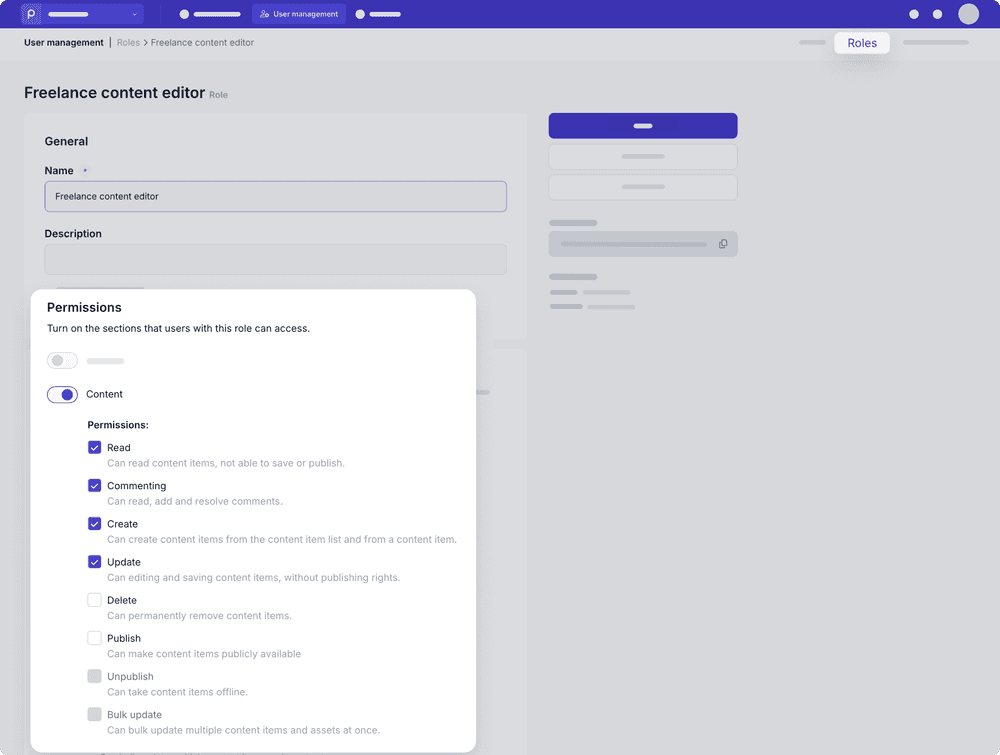
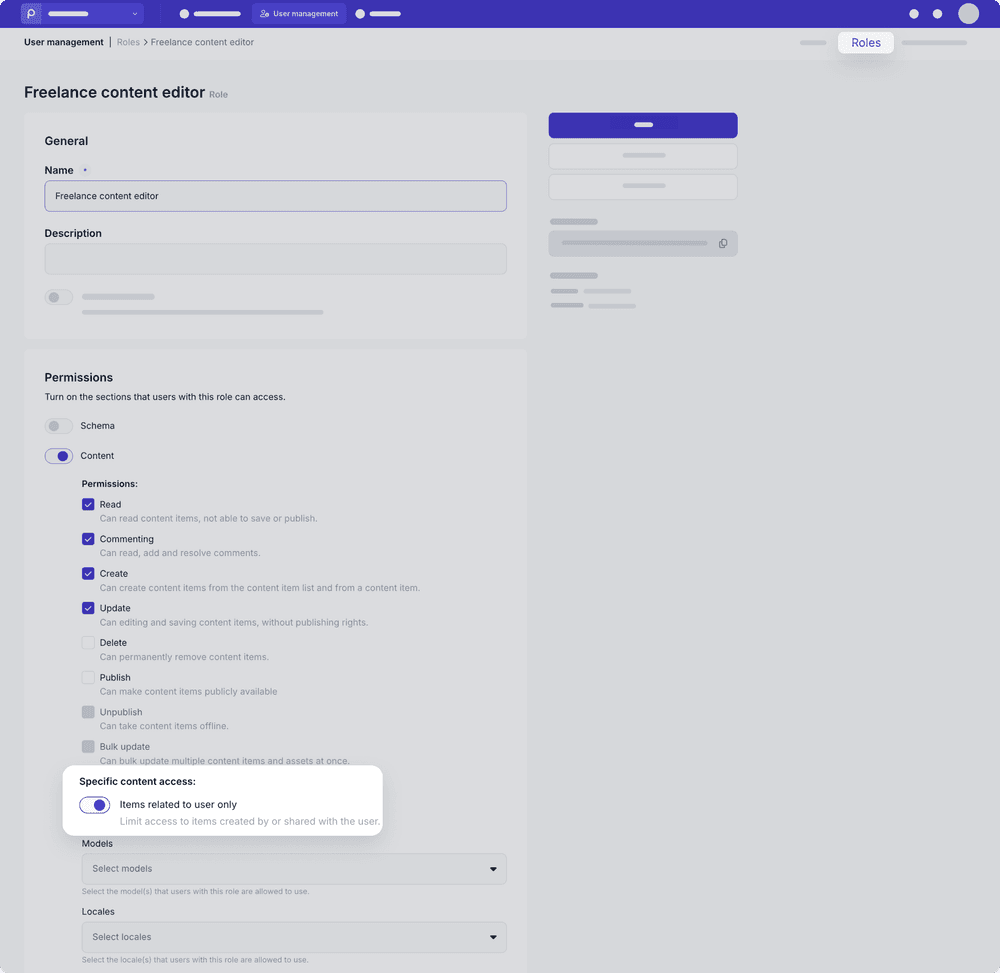
With action-based permissions, Prepr allows teams to define role access more precisely. Actions such as creating, reading, updating, commenting on, publishing, or unpublishing content can be assigned independently, and only where they make sense.
This is often useful in situations where responsibilities are narrowly defined, for example when working with external contributors. A freelance translator, for example, may need to edit content but should not be able to publish it or change workflow states. By assigning only the actions required for the task, teams can give freelancers the access they need while keeping final control with internal roles.
This makes responsibilities clearer and reduces the risk of accidental changes, especially in workflows where content passes through many hands.
Scoped access by workflow stage
Granular permissions can now be scoped by workflow stage. This makes it possible to limit roles to specific stages in the editorial process, adding another layer of precision to role-based access control.
For example, a reviewer may only need to see content in the Review stage, while a translator may only work on content in earlier stages. By restricting visibility based on workflow stage, teams can reduce noise and avoid accidental edits.
This addition builds on existing scoping options, such as locale and content models, and further strengthens Prepr’s role-based access system by aligning access even more closely with real editorial workflows.
Sharing access to individual content items
In some situations, access needs to be limited to a specific content item rather than a broader set of content.
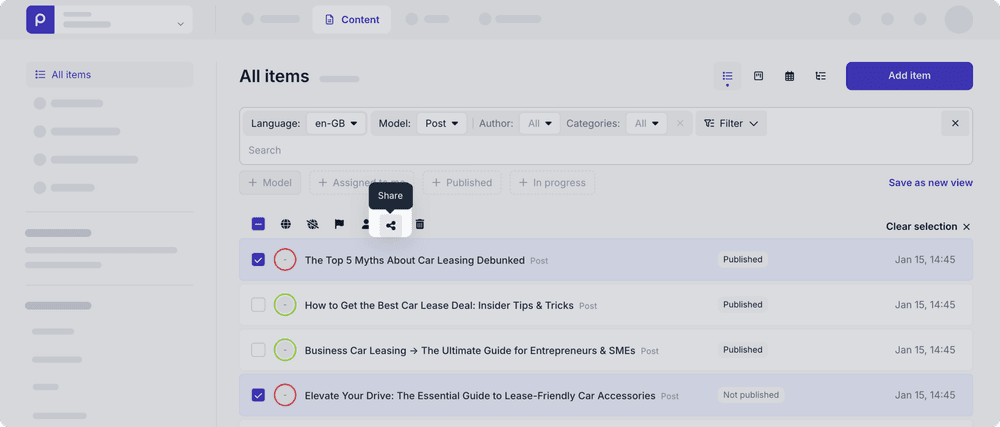
A freelancer may only need to work on one article or an external reviewer might be involved in a single piece of content. With direct content item sharing, Prepr allows administrators to grant access to a specific content item, and nothing more. One item can be shared with selected users without changing their role or opening up access to other content.
This makes short-term collaboration easier to manage. External contributors can work on the content they’re responsible for, while the rest of the content remains hidden. When the task is done, access can be removed without touching role settings.
Requesting access when content is locked
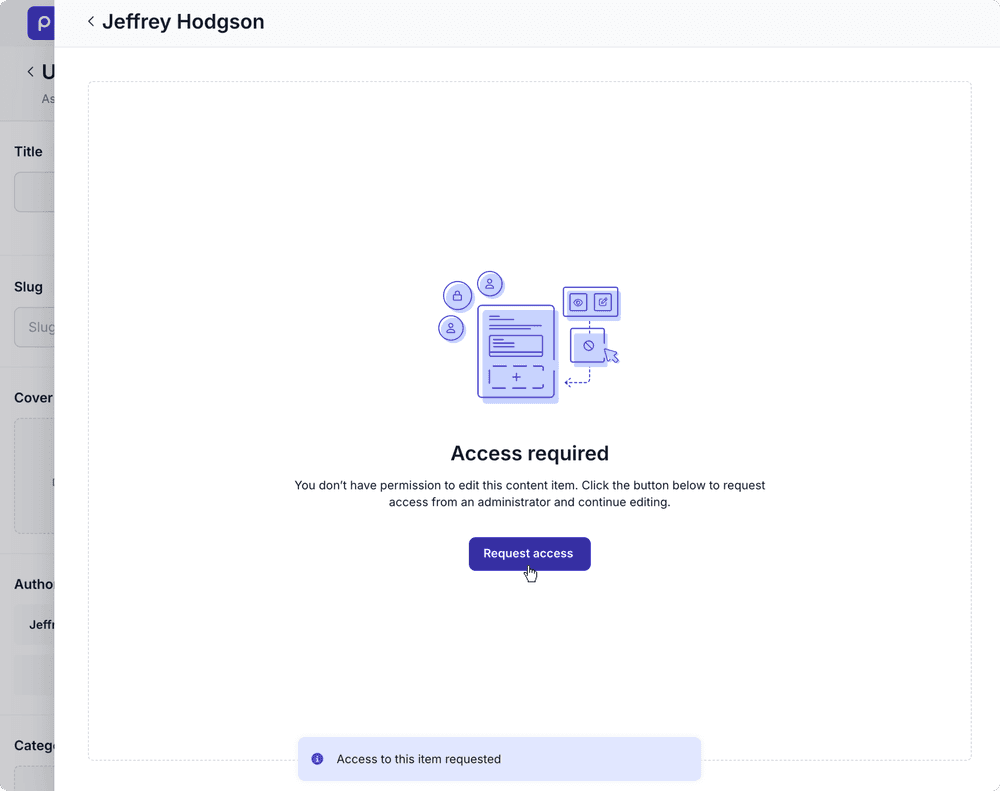
Even with clearer permissions, situations come up where someone needs access to a specific piece of content they can’t currently open. Often this happens through content references, where one item depends on another.
In many teams, the response is predictable. Someone reaches out to an admin, switches tools, and waits. Work pauses, not because access shouldn’t be granted, but because the process to grant it sits outside the workflow.
On-demand access requests bring that process into the CMS. When a user encounters content they don’t have access to, they can request permission directly. The request can then be reviewed and approved, allowing work to continue without changing roles or expanding access more than necessary.
Showing only the content you created
For freelance editors or temporary contributors, seeing large volumes of content can be distracting and, in some cases, risky. Their responsibility is often limited to the items they are actively working on, not the broader content landscape.
With the option to show only the content items a user created, visibility can be reduced even further for specific roles. Contributors see their own work and nothing else. This keeps attention where it belongs and lowers the chance of accidental changes outside their scope.
For teams working with external contributors, this adds another layer of control without adding complexity to role management.
Designing access as part of your workflow
Access control plays a central role in how organizations protect content and data. As CMS platforms support more people, more workflows, and more external collaboration, access decisions increasingly shape both security and day-to-day operations.
In distributed content teams, permissions are rarely static. Responsibilities change over time, work moves through different stages, and contributors are often involved for a limited scope or duration. Access control needs to reflect that reality without becoming complex to manage or easy to misconfigure.
Prepr’s granular access controls build on its role-based foundation to support these scenarios. Permissions can be tailored to responsibilities, tasks, and moments in a workflow, whether that means giving a freelancer access to a single article, allowing a reviewer to focus only on items that need attention, or keeping visibility tightly scoped for temporary contributors.
The result is a CMS setup that supports collaboration without relying on workarounds, and governance without constant manual intervention. Security and workflow efficiency are not treated as trade-offs, but as complementary requirements designed into the system from the start.