

Frontend development is moving fast again.
Ask developers what stands out most about 2025, and the answer is almost always the same: the pace.
New frameworks, new rendering patterns, and a constant stream of AI-powered tools arrive almost every week. Kevin Quaedvlieg, one of our frontend developers at Prepr, describes it like this: “Every week there’s something new, Cursor, Windsurf, Claude, Claude Code, Amazon’s Kiro. We went from simple coding assistants to fully integrated AI IDEs. I’ve tried a lot this year, and I keep coming back to Claude, Claude Code, and Cursor.”
When asked to describe the state of frontend development in a single word, he doesn’t hesitate: “Server-First.”
The shift is clear: more work happens on the server, less JavaScript ships to the browser, requests are fewer, and bundles load faster. The result is a web that feels lighter, and a development process that depends more on strong defaults than manual optimisation.
Meta-frameworks are the standards
Going into 2026, the stack feels more mature and more opinionated than it did a year ago. Recent Stack Overflow data shows React still leading by a wide margin, Next.js expanding its role as the default meta-framework, and Svelte and Astro steadily gaining space.
For most frontend teams, 2026 no longer starts with the question “Which framework should we use?”.
The ecosystem has consolidated. Meta-frameworks like Next.js, Astro, SvelteKit, Remix, and Qwik have become the default starting point for new projects.
Developers describe this shift as practical rather than ideological. Meta-frameworks simply take care of the work that used to slow projects down: routing, data fetching, server-side rendering, build optimisation, and deployment targets. As frontend developer Kevin Quaedvlieg puts it, “These frameworks come with an opinionated approach that works out of the box and solves the problems you keep facing on every project.”
Performance may have sparked the early enthusiasm, but it isn’t the only reason teams stick with these tools. Kevin says it’s a mix: better performance brought developers in, better developer experience kept them there.
Next.js leads React projects with server components and strong edge tooling; Astro appeals to teams building content-heavy sites with minimal JavaScript; SvelteKit and Qwik attract developers who want smaller bundles and fast rendering; and Remix has settled into a stable position as a server-focused React framework.
Looking ahead, new contenders are already generating interest. Kevin points to TanStack Start as one to watch, a sign that even in a consolidated market, there’s room for frameworks that rethink routing or performance fundamentals.
React and Next.js dominate framework popularity, but Astro and Svelte gain ground
If 2025 proved anything, it’s that the frontend ecosystem is stable at the top and dynamic at the edges. The latest Stack Overflow survey places React firmly in the lead at 44.7 percent, with Next.js at 20.8 percent, confirming that most teams building modern web interfaces still rely on the React ecosystem. Angular (18.2%) and Vue (17.6%) remain steady, supported by mature communities and long-term enterprise adoption.
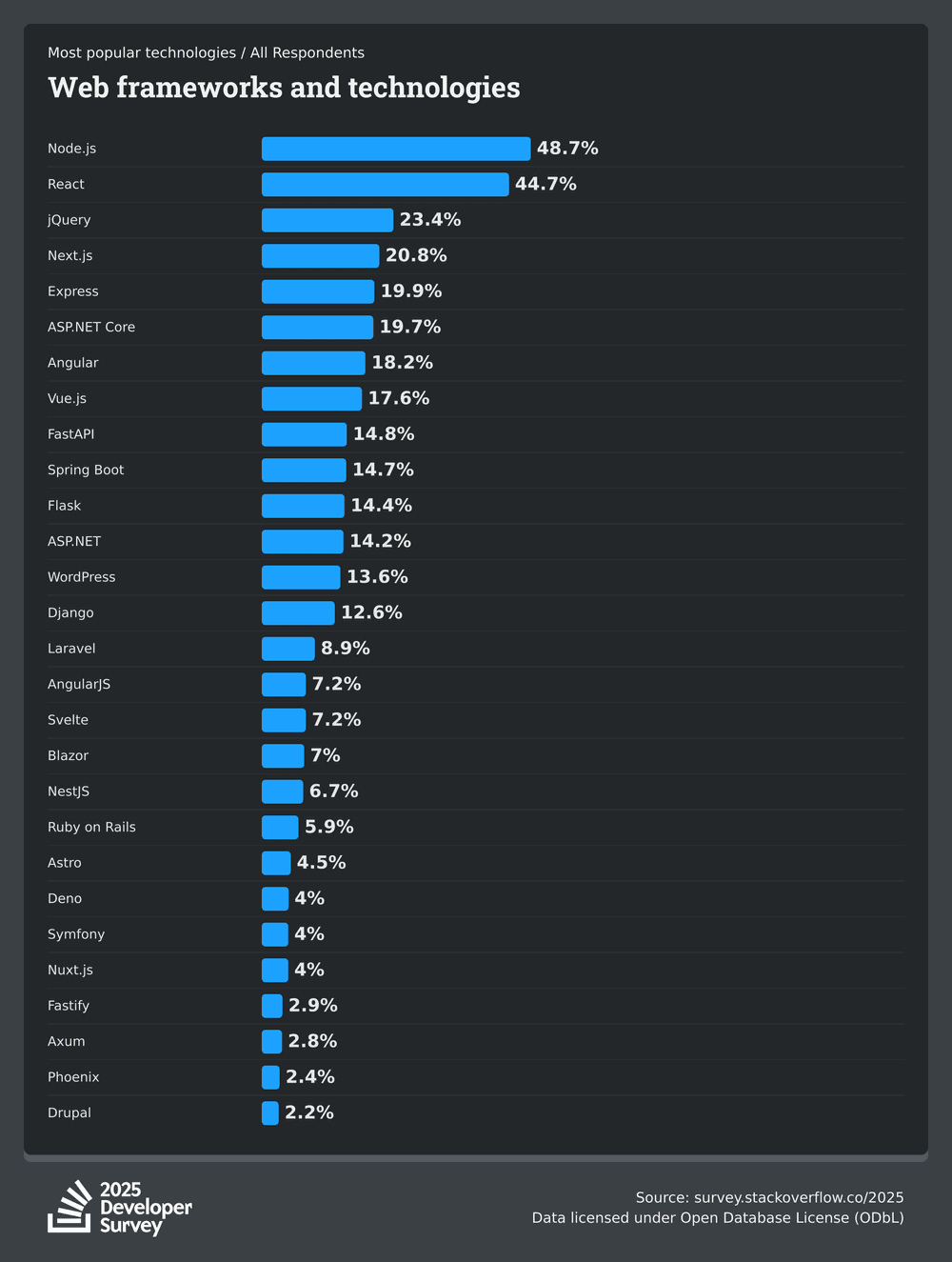
The broader State of Frontend survey echoes the same pattern. Nearly 70 percent of developers there say they use and like React, and more than half report using Next.js as their main rendering framework. Meanwhile, lighter frameworks like Svelte, SvelteKit, Astro and Qwik continue to attract interest among teams focused on performance, simpler builds or content-heavy use cases.
The numbers tell a clear story: the core of the ecosystem hasn’t changed, but the edges are moving.
Hybrid rendering, the default approach to building pages
A few years ago, frontend teams spent a lot of time choosing between CSR, SSR and SSG. Each approach had benefits, each had drawbacks, and every project started with the same debate: render on the client, the server, or ahead of time?
Going into 2026, that debate is essentially over. Developers no longer pick a single rendering strategy, but they mix them on the same page. This shift has become one of the defining trends in modern frontend development.
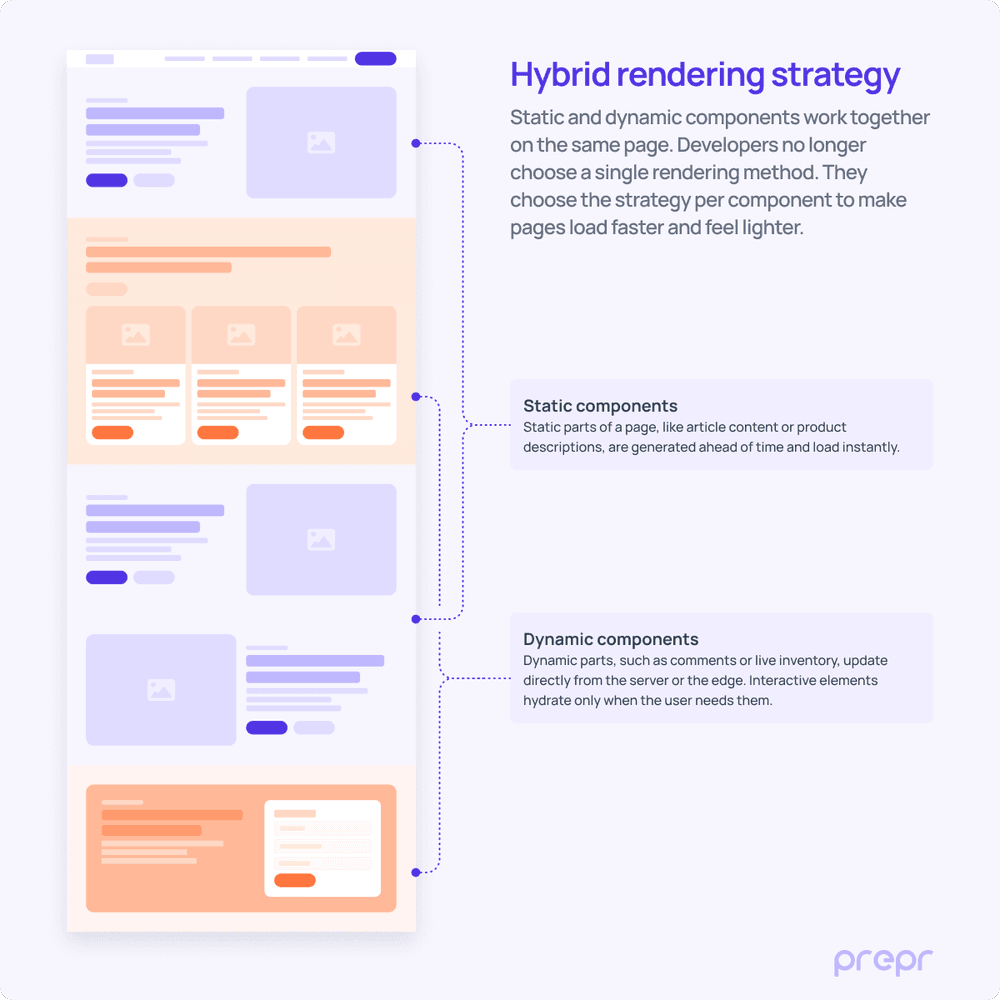
Hybrid rendering now works on a per-component basis. Static parts of a page, like article content or product descriptions, are generated ahead of time and load instantly. Dynamic parts, such as comments or live inventory, update directly from the server or the edge. Interactive elements hydrate only when the user needs them, following the islands architecture popularised by frameworks like Astro and Qwik.
Terms that felt niche a year ago, partial hydration, progressive hydration, and edge rendering, are now part of everyday discussions. Developers plan pages piece by piece, choosing the rendering approach based on what makes each section feel fastest and lightest.
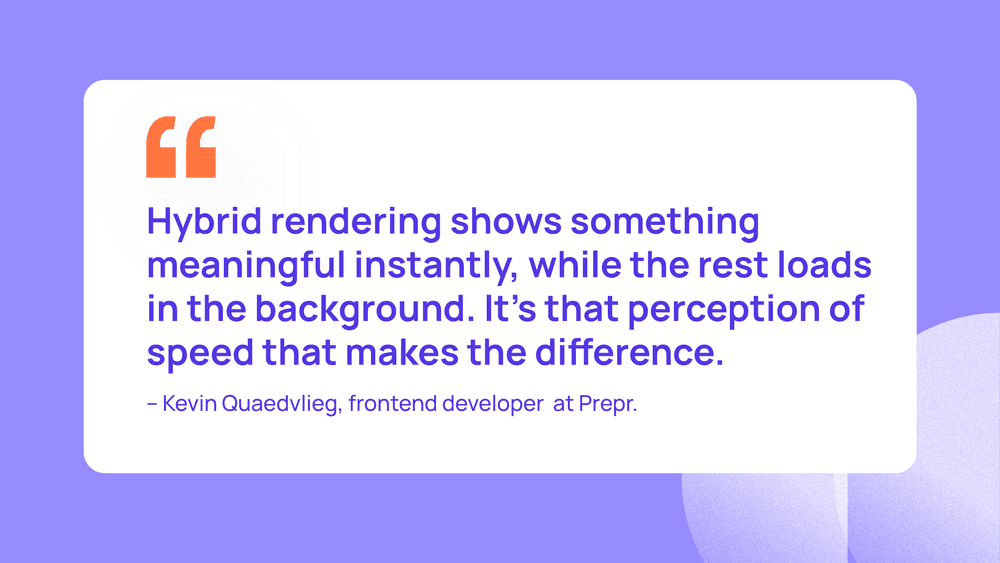
One of the key advantages of hybrid rendering is also the one most users never notice: it lets teams show something meaningful on the screen immediately while the rest of the page continues loading in the background. That perception of speed is often more important than the actual milliseconds saved.
This shift also changes how teams plan projects. Instead of asking, “Which rendering method should we use?”, the question becomes, “How should each piece of this application render?”. It’s a more flexible mindset, and one that modern meta-frameworks support by default.
Frontend teams now use AI across most of their workflow
A year ago, AI tools mostly lived on the edges of frontend development. GitHub Copilot suggested small snippets, fixed syntax errors, and filled in boilerplate. Today, AI sits inside the workflow itself. It doesn’t just autocomplete code, but it helps plan features, generate components, audit accessibility, and propose performance improvements.
The adoption curve has been steep. 84% of web developers use AI tools in some form, and around a quarter of the average codebase now includes AI-generated input, even if most of it still passes through human review. Another industry report highlights a similar shift: 91% of developers say they now use AI to generate code, at least occasionally.
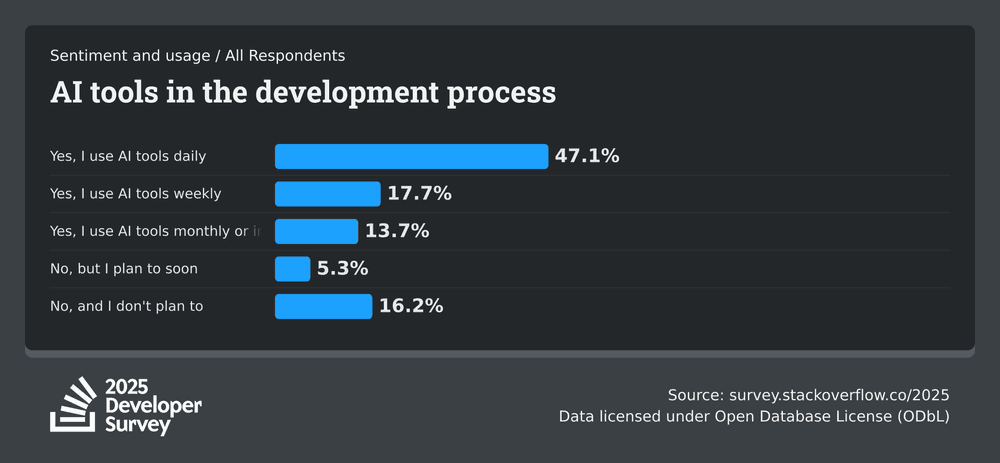
Inside engineering teams, the daily toolbox reflects that change. At Prepr, developers rely on a mix of ChatGPT, Cursor, Gemini, and other AI tools depending on the task. Some prefer an IDE-integrated workflow, others use conversational models to explore architectural decisions before writing any code. The choice is less about brand loyalty and more about personal taste.
For many developers, AI is at its best when starting something new. Davy De Vries, solution architect at Prepr, says that when he creates a fresh function or component, he often lets AI generate the first version, then shapes it manually. But when the task touches an existing codebase, the approach changes; the AI output is always double-checked. The balance between speed and control is still a human decision.
This is also why developers describe AI less as a shortcut and more as a decision-making tool. It doesn’t always make them faster, but it often helps them make better architectural choices simply because they can explore more options in the same amount of time. As Davy puts it, AI helps him “research more paths at once.”
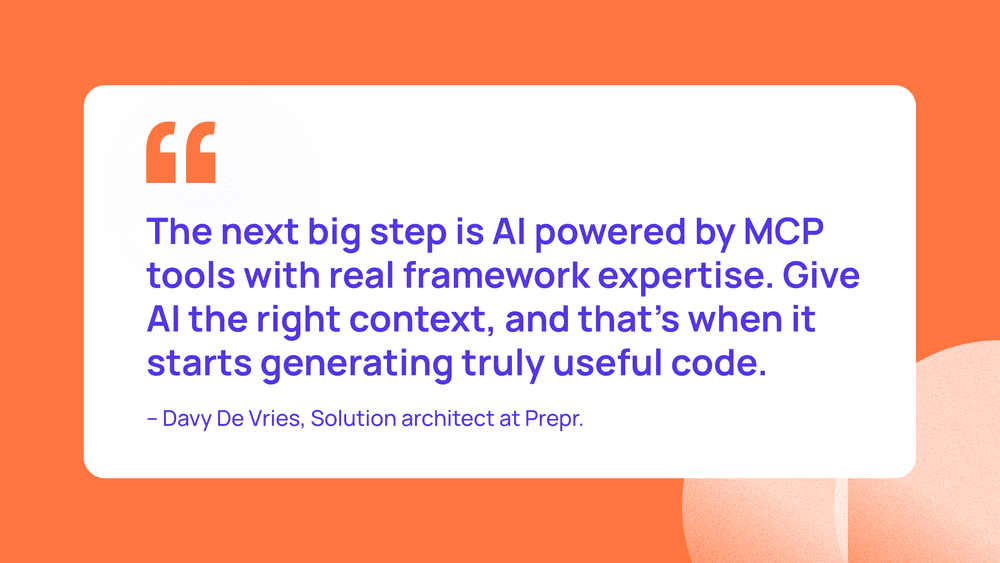
Looking ahead, the enthusiasm is cautious. Davy feels that today’s tools, while useful, are reaching a ceiling. AI can generate 70–80% of a component, but a well-maintained boilerplate project is often still faster. He expects the next wave to come from MCP (Model Context Protocol) tools, systems that give AI deeper knowledge of frameworks like Next.js or Astro, resulting in more accurate, context-aware code.
Personalization fits naturally into today’s frontend setups
Modern frontend frameworks have made something possible that used to be difficult: delivering personalized experiences without slowing pages down. With hybrid rendering, most of a page can remain static and load instantly, while only the components that need user-specific content are rendered on the server or at the edge.
In practice, this changes how teams design pages. A blog post, product page or landing page can be generated ahead of time and served as a fast, lightweight static file. But a “recommended for you” block, a dynamic hero message, or a returning-user banner can pull personalized data at request time, often from the edge, without affecting the performance of the rest of the page.
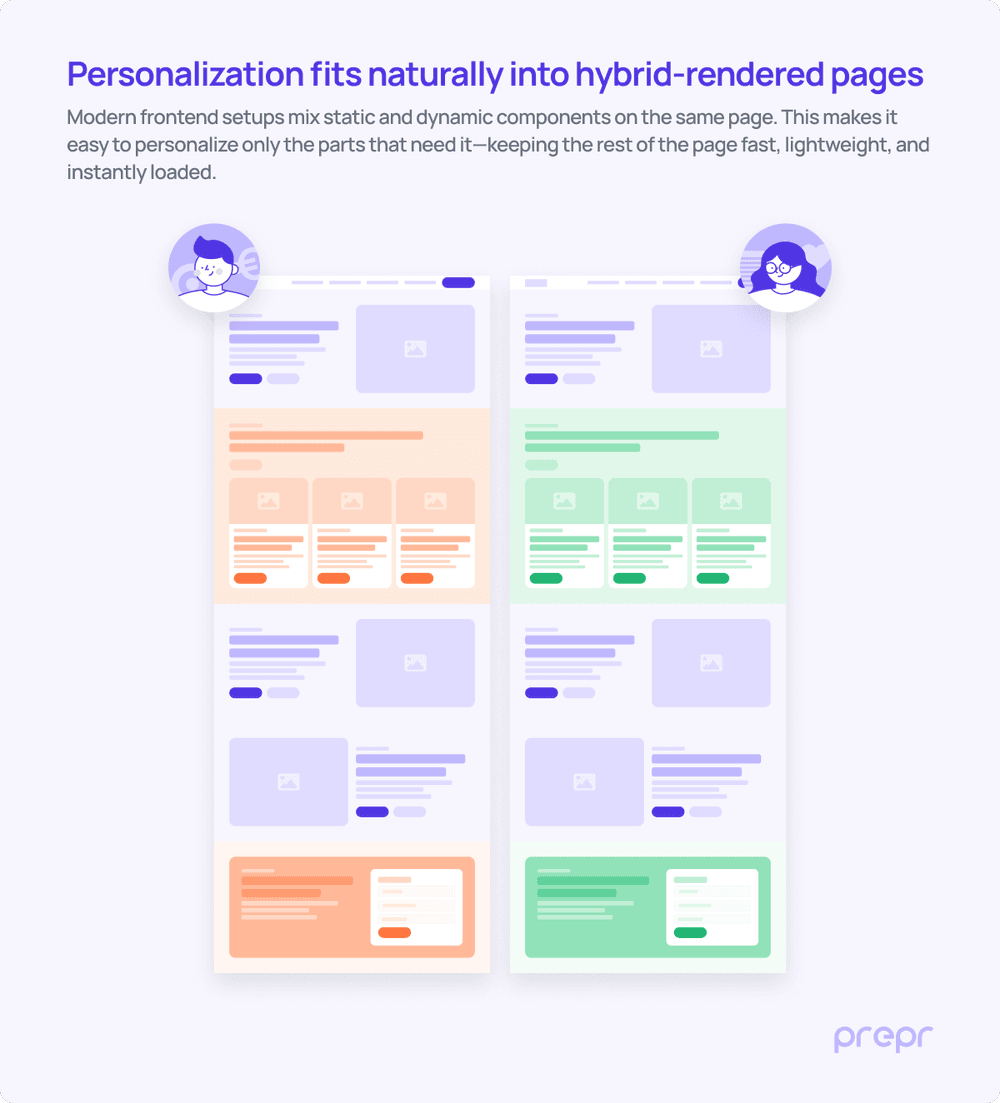
This model fits naturally with a headless CMS that supports built-in personalization like Prepr. Prepr delivers structured content through APIs, and frameworks like Next.js decide when and where to render it. Developers no longer have to choose between speed and personalization; they can combine both in the same interface, component by component.
The result is a frontend architecture where personalization is simply another part of the system, not a performance trade-off. Teams can run A/B tests, tailor content by audience, or deliver individualized recommendations while keeping the core experience as fast as a static site.
The frontend lessons that matter for 2026
The past year clarified many of the frontend framework trends of 2025. Meta-frameworks moved from promising options to the default foundation for new projects. Rendering shifted from choosing CSR, SSR or SSG to combining them at the component level. And AI went from an assistant for small tasks to a tool that shapes how developers explore solutions and plan their work.
The usage data confirms the same direction: React remains the centre of the ecosystem, Next.js extends what React can do, and lighter frameworks like Svelte and Astro continue to gain ground among teams focused on performance and simplicity.
Modern architectures now make it possible to keep pages fast while still adapting content to individual users. Hybrid rendering and edge functions pair naturally with headless CMSs that support built-in personalization, allowing teams to mix static speed with dynamic experiences without trade-offs.
If there’s one thread that ties these trends together, it’s maturity. The tools feel more stable, defaults are stronger, and developers spend less time assembling their stack and more time shaping the actual product. The pace of change is still fast, but the direction is clearer: a server-first mindset, smarter frameworks, and AI that increasingly becomes part of the workflow.
Going into 2026, frontend development is defined less by disruption and more by refinement. Teams have the tools they need; now they focus on using them well.